
Spring Garden’s skyline is about to transform
Demolition in downtown block makes way for a new 30-storey development
caption
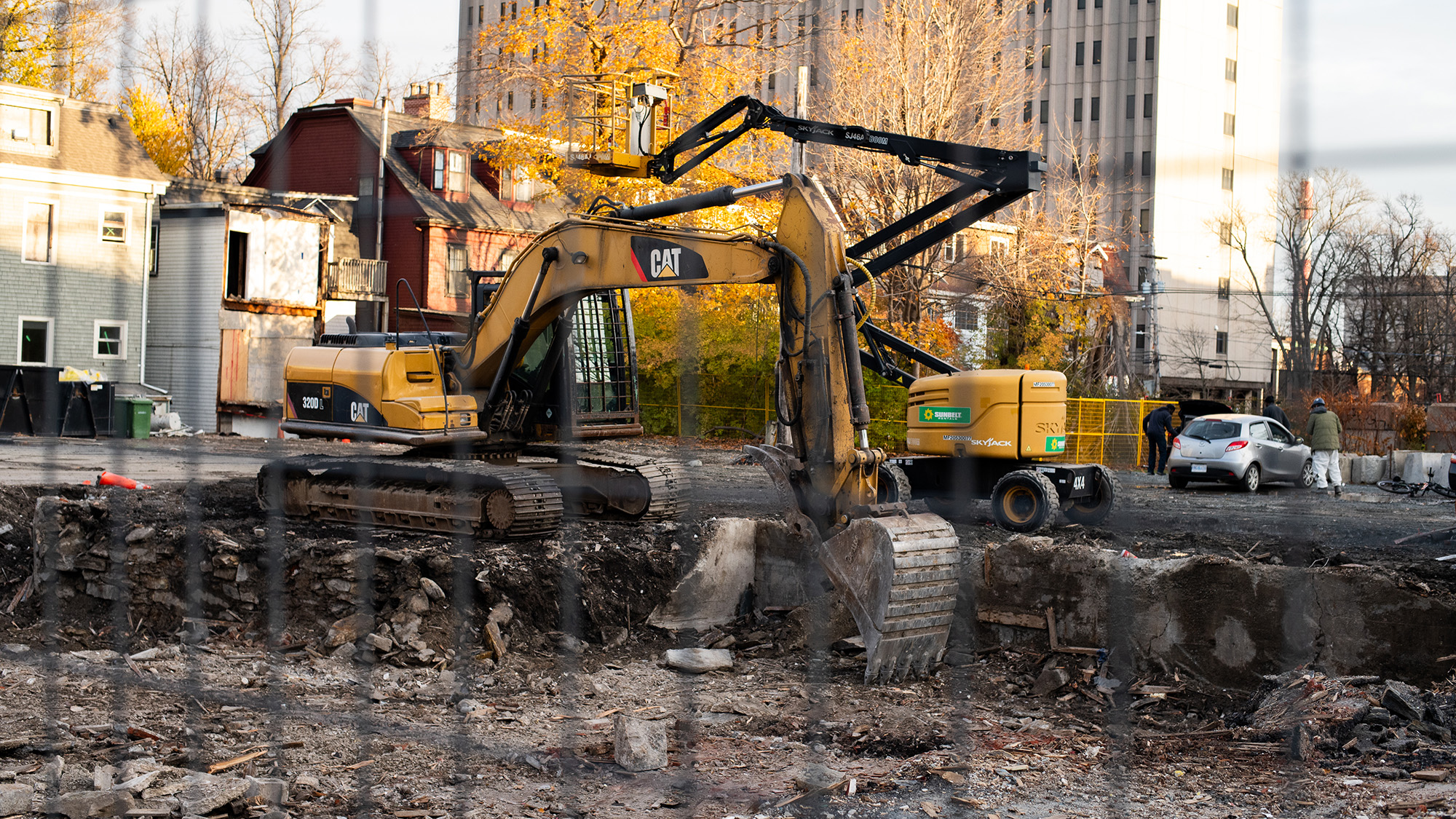
An excavator digs at the foundation of one of the former buildings on a development site on Spring Garden Road.Passersby on Spring Garden Road this month will find it hard to miss excavators tearing down buildings along the stretch between Carlton and Robie Streets.
While some of the houses still stand, about 19 units along Spring Garden, and one on Robie Street, will be torn down by February to make room for a new residential and commercial development.
The development includes four heritage properties along Carlton Street, which will be restored to their original facades.
The new development consists of two towers, each 30 storeys high, totalling around 300 rental units. About 45 of those rentals will be affordable apartments priced at around 30 per cent below-market rent. The bottom floor of the development is dedicated to commercial space.
The properties are owned by Dexel, a Halifax development firm that says they’ll complete the construction in about five years.
“We’re going to work very hard in terms of our tenants,” said Kris Skiba, Dexel Development’s vice-president of design and construction.
“So we can ensure we’re still going to be good fits for the neighbourhood, from our commercial tenants to the residents.”
Zuppa, a theatre company, rented space in one of the Carlton Street properties. Alex McLean, a co-artistic director of the group, says the company knew the building was set for development when they took over the space in 2018. They signed a one-year lease with Dexel’s sister company, Paramount Management, and ended up staying until construction started.
“I have a kind of nostalgia for some of those old rickety buildings … There’s always that sadness to see something go. But I think it’s good that we’re building things in Halifax,” said McLean.
“I have a kind of nostalgia for some of those old rickety buildings … There’s always that sadness to see something go. But I think it’s good that we’re building things in Halifax”
Alex McLean
Zuppa has since found a new location on the opposite side of Carlton Street, though the search was tricky because rents have increased notably since they last moved nearly seven years ago.
“For a while, it was looking like we might have to go quite far afield to get something in the same sort of ballpark as to what we were renting previously,” he said.
William Ceballos, a Dalhousie University student currently living on Carlton Street, struggled to find a place to rent before moving in a couple years ago.
“I think (the development) might be okay because it could offer more people lower rent and more options because finding a house as a student is really hard,” Ceballos said.
The area around Spring Garden, between Robie Street and Summer Street, was designated by the municipality a “centre” in 2017. Areas designated as centres have existing good transit and commercial shops that can be developed with high-rise buildings to increase density.
Alongside these two towers, additional multi-storey developments are planned for the same block.
The new building, with its proximity to the university, could offer students more housing options says Jill L. Grant, a city planning professor at Dalhousie. But, she said, families and other residents may shy away from sharing housing with potentially loud students.
Additionally, high-rise buildings usually have very high infrastructure and building costs, which make it hard to offer affordable housing, said Grant.
“Taller developments can increase the overall supply of housing,” she said. “Whether they can help address housing shortage is doubtful as most families cannot afford to pay the cost of a luxury apartment.”
There are also environmental concerns regarding the construction of high-rise buildings, because they use more materials like concrete, steel, aluminum, and glass that have a higher carbon footprint.
“We’re basically building carbon bombs,” said Peggy Cameron, a representative of Development Options Halifax, a group opposed to the demolitions.
Taller buildings also use more energy, she said.
“If you have buildings that are jutting up high … they’re just more exposed to the elements,” said Cameron. “They get more wind which has a cooling effect or they get more sun. They’re just like up there in the place where it’s harder to control what the elements are doing.”
About the author

Isabel Duque
Isabel Duque is a reporter for The Signal and a student in the Masters of Journalism program at the University of King’s College.

Leave a Reply