
By the numbers: Eight years of road crashes in Halifax
caption
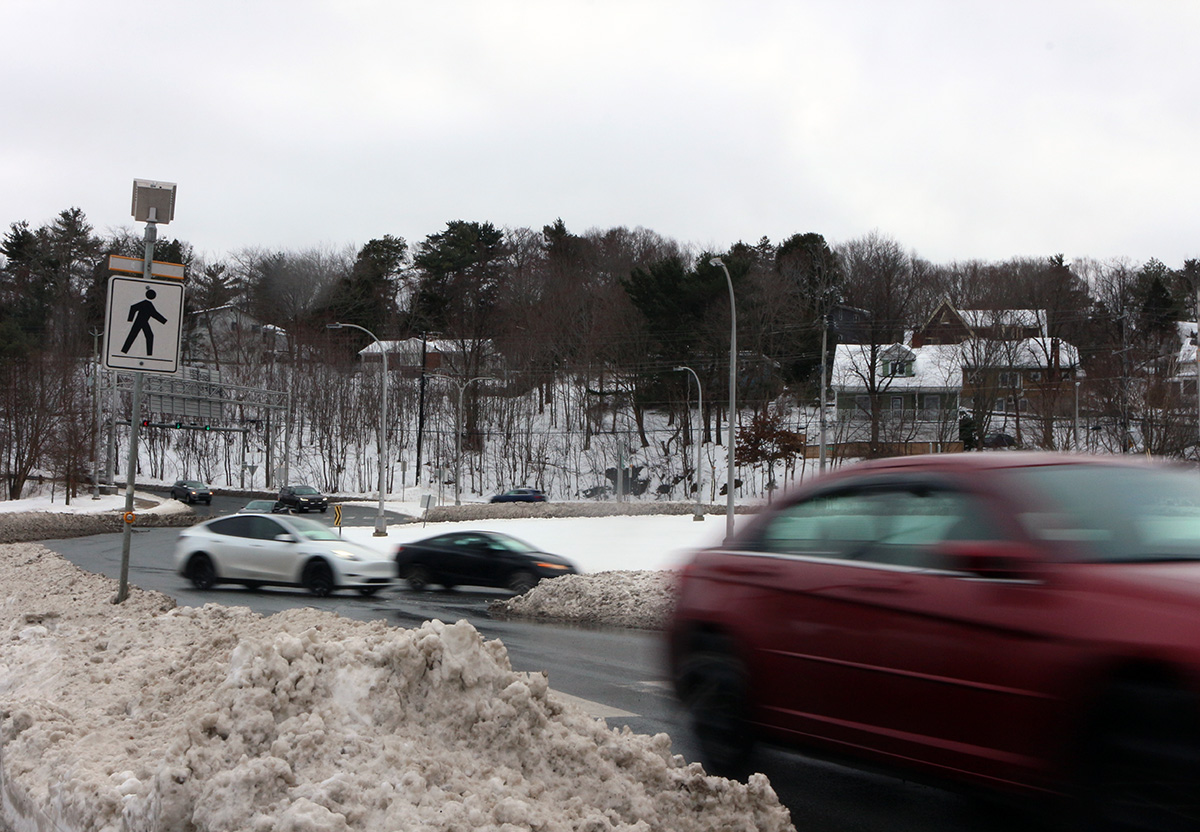
Cars entering the Armdale rotary in Halifax. According to the data, the Armdale rotary is the most dangerous place to drive in Halifax, with 438 vehicle collisions since 2018Collision data shows little change from 2018-25, despite city efforts to reduce crashes
One hundred people have died in vehicle collisions in Halifax since 2018. One-fifth of them were pedestrians, four of whom died in 2025.
The Signal analyzed HRM’s open traffic collisions database, alongside accident and vehicle information databases provided by the municipality. The data included over 44,000 collisions that occurred on HRM’s public roads between 2018 and 2025. The data represents every time a vehicle hit a vehicle or multiple vehicles, or a vehicle hit a pedestrian or a cyclist, and was recorded by police and shared with the municipality.
The data help paint a picture of Halifax’s roads and how safe they are for pedestrians, cyclists and drivers.
Out of the 1,332 pedestrian collisions in the database, 20 were fatal while 80 out of the 42,813 vehicle collisions were fatal.
Eight of the 20 recorded fatal pedestrian crashes were classified by the Halifax Regional Police or RCMP as cases of aggressive driving. Of those eight, three were additionally classified as distracted driving and another two were impaired driving. Seventeen of 20, or 85 per cent of drivers who killed pedestrians, were not charged with criminal offences.
The details regarding the death of Edward Creelman, who was killed by a Halifax transit bus at Dartmouth’s bridge terminal in 2022, are not represented in the data here, as his death was not included in the dataset. That’s because the collision happened on a privately-owned street, according to HRM staff. There were two other pedestrian deaths occurring on private property that were included by mistake in the database, according to staff: Maverick Brown who was killed on Brownstone Way in Bedford in 2025 and an unnamed victim from 2023 on Farmers Dairy Lane, near Bedford.
The death of Alexandria Wortman was also classified improperly in HRM’s database as an in-vehicle fatality, rather than a pedestrian fatality. The Signal manually added the details of Wortman’s death and removed the details of the known deaths on private property in its research, in order to accurately portray collisions on public streets in HRM.
The year with the most collisions was 2019 with 6,266 crashes, followed by 2024 and 2018. The lowest volume of collisions occurred during the first year of the pandemic, 2020, with 4,569.
In 2023, HRM committed to achieving a rate of zero vehicle collisions that result in fatalities or serious injuries by 2038. Since then, the rate has dropped from 175.3 per 100,000 people to 158.4 per 100,000 people in 2025. According to The Signal’s calculations, the rate would have to drop by 12.8 each year in order to achieve that goal.
Across all crashes, 45 per cent of incidents were recorded during the five-month stretch of November to March.
December had the most pedestrian-related crashes in the past eight years, with around 14 per cent. Meanwhile, November and January accounted for one-fifth of pedestrian fatalities each.
Around 32 per cent of all crashes occurred in peak-traffic hours, from 3 p.m. to 7 p.m. Similarly, 30 per cent of all pedestrian crashes happened within that time frame.
Six of the 20 pedestrian fatalities happened during and just after peak-traffic hours, from 5 p.m. to 8 p.m.
Friday and Thursday are the days of the week with the most recorded crashes. Both days followed the same rush-hour pattern, with around 33 per cent of crashes happening each day within the hours of 3 p.m. to 7 p.m.
Passenger cars — any car that isn’t an SUV, pickup truck or van — were involved in almost 60 per cent of all crashes between 2018 and 2024. Vehicle data for 2025 does not currently match overall collision data, so it has not been included in The Signal’s analysis.
SUVs account for around 16 per cent of all collisions, and pickup trucks account for eight per cent. This generally lines up with 2024 car ownership rates for wider Nova Scotia, where 16 per cent of licensed vehicles were pickup trucks and 36 per cent were multi-purpose vehicles, which includes SUVs.
Despite the lower percentage of SUVs and pickup trucks in all crashes, the two vehicle types were overrepresented in pedestrian-related crashes and pedestrian fatalities. Pickup trucks were involved in 10 per cent of all pedestrian crashes and were involved with 18 per cent of pedestrian fatalities — or three deaths.
SUVs had the largest jump between total crashes to pedestrian fatalities. An SUV was involved in four of the 20 fatalities, accounting for 24 per cent of pedestrian deaths.
Bicycle collisions increased in 2025 by 16 per cent from the year prior, reaching 101 collisions for the year. It has risen by 71 per cent since 2018.
The day with the largest quantity of crashes in the last eight years was Jan. 22, 2021, with 91 crashes. One of the collisions in the early morning involved a pedestrian. According to weather history, there was snow all day on Jan. 22.
The second-highest collision days were Dec. 7, 2018, where there was sleet and fog almost all day, and March 8, 2018, which had light snow, ice and fog. Both days had 67 crashes.
Despite those high volume days, out of the 1,332 pedestrian collisions, 63 per cent occurred in clear weather conditions, equaling 841. Out of the 841, five per cent occurred when the street was wet. Rain and overcast collisions followed with 212 and 190 cases, respectively.
These figures are reflected similarly in fatal pedestrian collisions. Out of the 20 pedestrian deaths, half occurred during clear weather conditions.
Three fatal pedestrian collisions happened in rainy conditions and it was overcast or cloudy during another three. There was one instance where the weather condition was not specified.
As of Feb. 10, no data has been released by HRM for collisions in 2026.
Halifax’s Road Safety Dashboard is updated monthly with the latest collision and traffic safety efforts.
About the author

Emma Breton
Emma Breton is a fourth-year Bachelor of Journalism (Honours) student. She enjoys reporting on the arts, public policy and local affairs.

Samuel Hodd
Sam is a fourth year journalism student at the University of King's College and Broadcaster for the UKC Blue Devils.

Leave a Reply