
Council, cyclists spar over bike lane safety
Municipal staff explores options to loosen standards; riders left frustrated navigating existing infrastructure
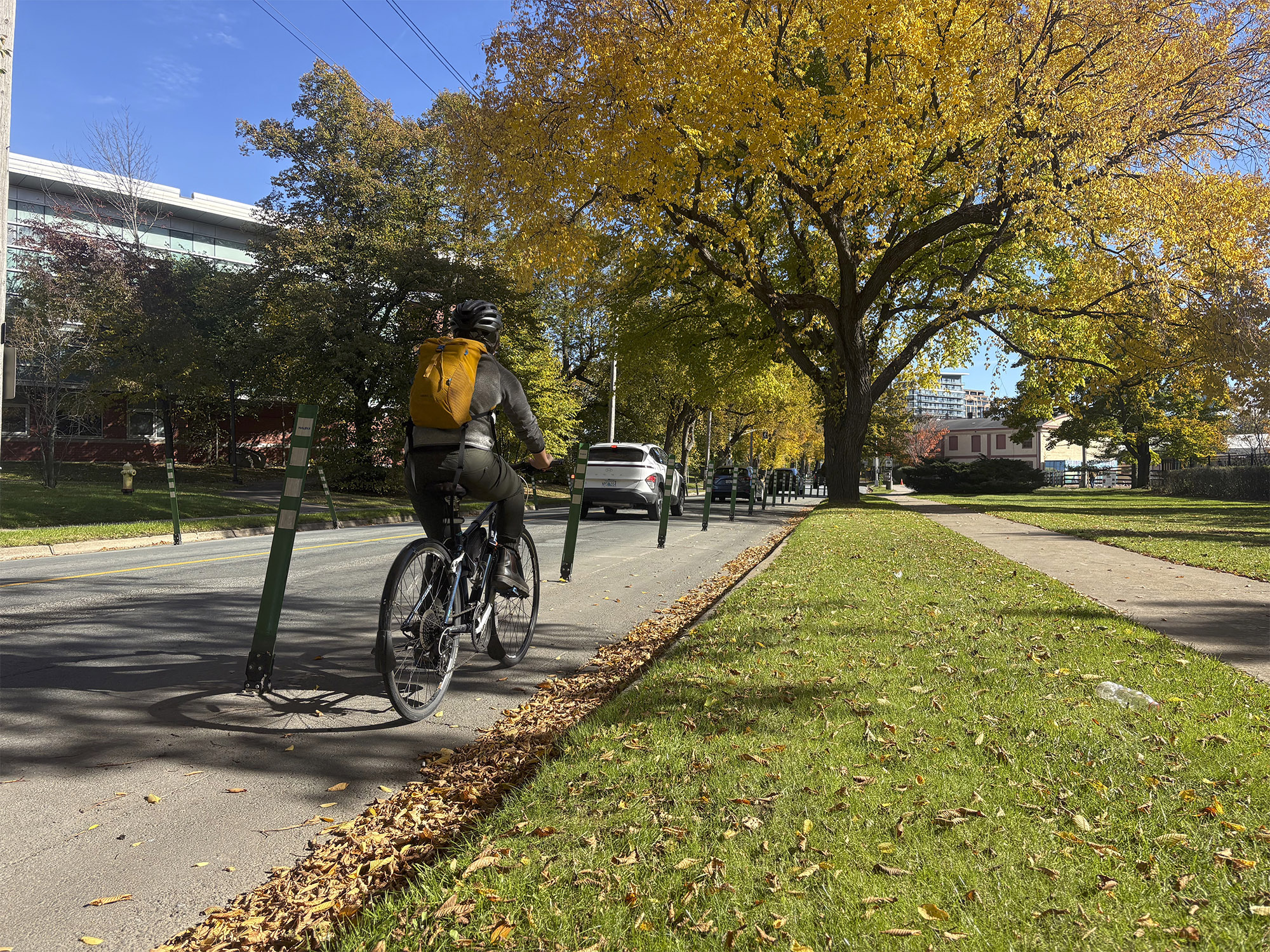
caption
A cyclist drives on a bollard-protected bike lane on Halifax's Bell Road.In August, cyclist Sofia So was struck by a motorist on the Vernon-Seymour bikeway in south-end Halifax.
“I stopped at a four-way stop and waited for the car to stop because I don’t trust cars,” So said in an interview. “I started going, and that’s when he hit me.”
So said the motorist did not see her in the intersection, and luckily for her the collision was minor.
Still, bike accidents are increasing on Halifax streets.
According to Halifax Regional Municipality’s open traffic collisions database, bicycle collisions more than doubled from 48 in 2020 to 101 in 2025. This year, Halifax had 53 reported bicycle collisions as of Nov. 1.
A March 2026 integrated mobility plan update said 60 per cent of the bikeway network in the regional centre has been completed. However, nearly one-third of the completed network is temporary infrastructure.
The current timeline for completion of Halifax’s network is the 2030 fiscal year. The fragmentation of Halifax’s network is a thorn in the side of cyclists.
“That’s the frustrating part — there seems to be great pieces around the city that are done well, but then they just stop,” said So.
HRM’s All Ages and Abilities (AAA) bicycle network is designed for cyclists of any riding level. The network consists of protected bike lanes, multi-use pathways and local street bikeways. Its aim is to increase the appeal of cycling to new cyclists.
“Halifax is not someplace I’d recommend to someone who’s new on a bike,” said Emiko Hourston, an experienced cyclist who has had many close calls with motorists.
“I’ll wear a high-vis vest, I’ve got high-vis tape on my helmet,” she said. “I’m not an invisible cyclist.”
In January, Halifax Regional Council approved a motion to plan alternatives to the AAA network. The motion came after a 2025 HRM staff report estimated $77 million of work was needed to complete the network. Previous funding from other levels of government amounts to $11 million, so $66 million would fall on the municipality.
District 7 Coun. Laura White voted against the motion and said the decision is worrisome.
At a February council meeting, Mayor Andy Fillmore requested a staff report to identify cost saving opportunities by considering lower safety standards than the AAA network would require and instead focusing on completing the network, rather than upgrading temporary segments.
In an interview, White questioned the mayor’s request. “Is it worth it to just tick a box… to say that we completed the network?”
Martin Brien, an active transportation planner with HRM, says the department is looking for ways to finish the network, “while still trying to provide the safest facilities.”
About the author

Matthew Copage
Matthew is a master's student at University of Kings' College.
Leave a Reply