
Is subscription-funded media more biased than ad-funded media?
Journalism experts weigh in on how funding models shape the news

caption
Canadian news experts and data say that subscription-funded media outlets are more politically biased — either to the left or the right — than solely ad-funded media outlets.Andrew Potter’s phone is vibrating off his desk. His inbox is flooded, too. Hundreds of variations of the same message are buzzing through over and over again.
Potter was editor-in-chief of the Ottawa Citizen. It’s 2013, and the daily paper ran two stories on the front page. The lead story was a news piece that Potter said was “picking on” Conservative Sen. Mike Duffy. To its right was a story detailing a negative report released about former Ontario Liberal premier Dalton McGuinty.
The messages blowing up Potter’s phone were from readers threatening to cancel their Citizen subscriptions after a conservative local radio show host instructed listeners to complain that the publication buried the article critiquing the Liberal premier. Potter was confused.
“It’s the first time I ever got yelled at for burying a story on A1,” he chuckled. “It’s on the front page. But it was on the right-hand side.”
Recounting the incident to The Signal, Potter clarified it wasn’t a bury. The lead story was written by a Citizen reporter, so it got top billing, while the McGuinty article was written by a wire service. Potter said it doesn’t matter that the “bury” wasn’t intentional; readers thought it was, and the subscriber is always right.
“In the new media environment, the readers are, for all intents and purposes, the owners of the outlet,” he said.
The Citizen is owned by Canadian-based media giant Postmedia. Subscribers contributed $130.2 million to Postmedia’s revenue for the 2024 fiscal year, about 33 per cent of the corporation’s total revenue.
“The subscription model definitely drives … content,” Potter said. “News people are chasing audiences right now, and it’s easier to find an audience when you have a consistent message. An easy way to have a consistent message is to have a consistent political leaning.”
The Signal examined 16 of Canada’s top media outlets — classifying them by one of two funding models: subscription-funded and ad-funded — to examine whether an outlet’s funding model affects its editorial bias. The Signal defined subscription-funded outlets as those that derived any revenue from subscriptions. Most subscription-funded outlets still generate some revenue from advertising.
Subscription-funded media outlets were more likely than ad-funded outlets to often agree with one of the federal political parties, according to a 2020 Université de Montréal study that surveyed 200 Canadian journalism, communication and political science professors.
On average, 82 per cent of experts could identify a federal party that each subscription-funded media outlet agreed with most often, while just 62 per cent of experts did the same for ad-funded outlets.
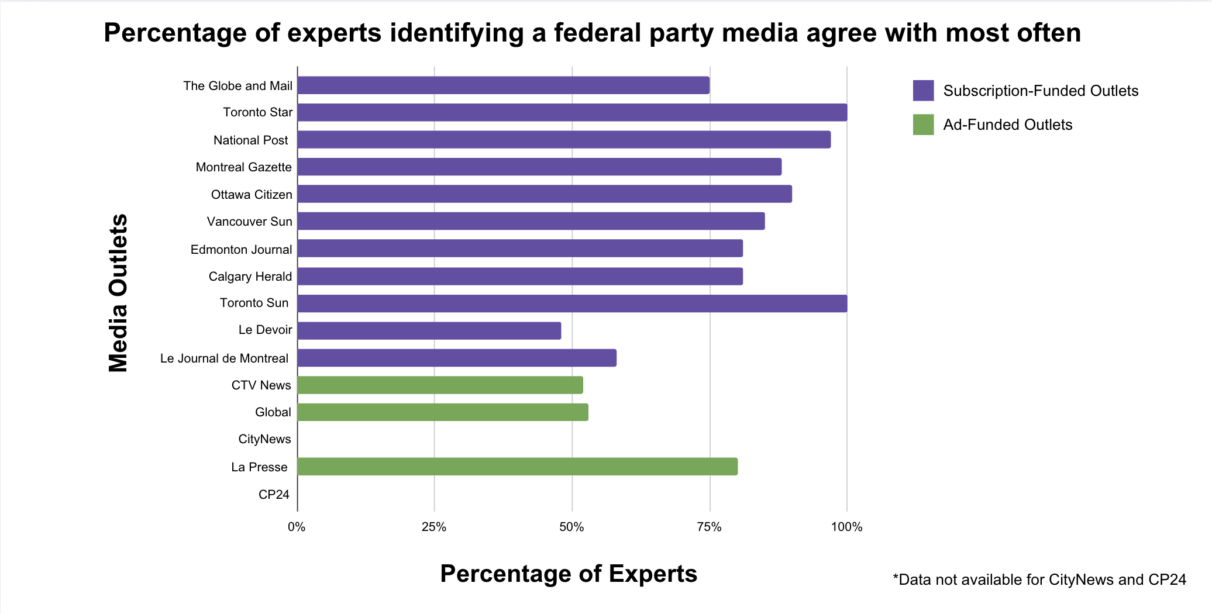
“The move to subscription has absolutely had a polarizing effect on the media,” Potter said. “You basically have to decide as a subscriber-based media outlet which way you’re going.”
Subscription-funded outlets are also more likely to have a right or left bias, according to data from Media Bias/Fact Check, a fact-checking website used in research by the University of Michigan and the Massachusetts Institute of Technology.
The Signal used Media Bias/Fact Check’s ratings of 16 major Canadian news outlets to identify a relationship between an outlet’s bias rating and funding model. On average, ad-funded outlets’ ratings fall closer to the political centre than subscription-funded outlets’ ratings.
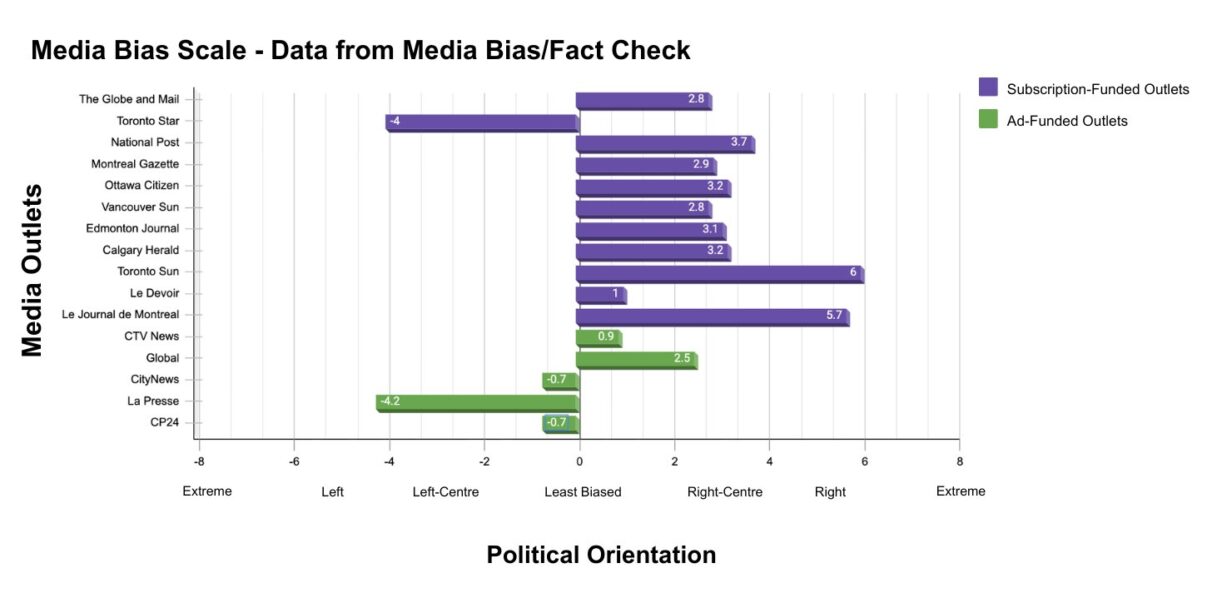
Potter said the business model of subscription-funded outlets forces them to become biased, either further left or right on the political spectrum.
“You don’t have the luxury of standing in the middle the way you used to with advertisers,” he said.
Readership drives ad revenue
Potter said when he started in media in the early 1990s, the biggest drivers of media bias were thought to be corporate advertisers and corporate owners. But when he started with the Citizen in 2011, he was surprised that advertisers didn’t editorially interfere.
“The interesting thing about advertisers is that they didn’t care what you published,” Potter said. “They just wanted an audience. The pushback was rarely from advertisers; it was always from readers.”
Postmedia said readership is what drives its advertising dollars.
“Our ability to attract advertisers and thereby generate revenue and profits is dependent in large part upon our success in attracting readership,” the corporation’s 2024 annual report said.
“Readership and to a lesser extent circulation volume are the key drivers of advertising prices and revenue in the Canadian news and newspaper information industry.”
Postmedia generates just 33 per cent of its revenue from subscribers, while almost 47 per cent comes from advertising. But the first step to securing advertisers is attracting people, said Corinna Lauerer, a journalism and economics researcher at Ludwig Maximilian University of Munich.
“Advertisers will only be interested if you get people on your platform who are interesting to them,” she told The Signal in an interview.
Since the rise of online news, Lauerer said advertisers shifted from going after large, general audiences to preferring smaller, targeted groups.
“If you have the people that advertisers want and you can prove that with data you collect, you can make money,” she said. “Not by being the biggest one, but a big one with a good audience.”
Several news experts who spoke with The Signal said that since the rise of online news, subscribers are more important to publications than advertisers.
“It’s only over the last decade that the drive for subscriptions became critical as digital media platforms killed advertising,” said Kathy English, the former public editor of the Toronto Star, a subscription-funded outlet. As public editor, English oversaw the newspaper’s ethical standards.
Print and digital advertising sales in Canada declined 26.1 per cent from 2022 to 2024, while digital circulation increased by 4 per cent, according to Statistics Canada. The small bump in digital circulation followed a massive 65.5 per cent increase from 2020 to 2022.
Potter said subscribers matter more to outlets than they used to, because news subscriptions are more expensive.
“It’s a big shift in power from advertisers to readers,” he said.
The data backs up Potter’s claim. A 2019 study from the University of Texas at Austin found that the average price of a seven-day home delivery newspaper subscription in America doubled from 2008 to 2016.
Bias, or good business?
English said every news outlet tries to cater to a specific audience, which is easier than ever because of real-time online reader data.
“In a subscription-driven digital newsroom, you now have the capacity to assess the impact of every single story and assess whether that story is driving subscriptions,” she said.
“There’s a desperation to drive up those subscription numbers because they represent much-needed revenue,” she said. “It’s appealing to what people are paying for.”
The operating revenue of Canadian newspaper publishers fell 17.9 per cent from 2022 to 2024, according to Statistics Canada, but the number of Canadians paying for news increased from 11 per cent in 2023 to 15 per cent in 2024.
English questioned if maintaining subscribers by “giving people what they want” should be considered “bias.”
“It comes down to, where is a subscriber going to put their money? It only makes common sense that there is a bias towards paying for what you agree with and that news organizations are going to do the stories that appeal to their readers.”
Janice Neil, a Toronto Metropolitan University journalism professor and former CBC senior producer, agrees with English.
“A chunk of the audience wants to read media that comforts them rather than challenges them,” said Neil. “They want to see their own views reflected back on them.”
English doesn’t see a problem with catering to subscribers, as long as outlets are following journalistic ethics.
“The Toronto Star describes itself as a progressive news organization, so it’s going to appeal to people with a progressive bias. This means they’re going to do more stories on homelessness, hunger, and issues that might be of interest to people with a progressive perspective.
“That doesn’t lessen the need to tell those stories in a fair manner.”
Alfred Hermida is a journalism professor at the University of British Columbia and the co-founder of The Conversation Canada. He agrees that bias isn’t a big deal if outlets follow journalistic ethics.
“The Globe and Mail has a bias,” he said. “It has a centre-right, pro-capitalist, pro-business, libertarian view of the world. And that’s fine. It still does independent fact-based reporting.”
English said an outlet’s “editorial perspective” is a form of bias, even when outlets like the Star are upfront about their perspective.
“We don’t have unlimited resources or space to tell every fact of every story. As soon as I decide what story a reporter is going to cover, there’s a bias. As soon as that reporter decides who they’re going to talk to, there’s a bias.”
Neil agrees with English. She said outlets don’t have the capacity to serve everyone.
“Trying to appeal to everyone means you’re appealing to no one, and it’s unsustainable in terms of resources,” Neil said. “You have to make choices every single day on the assignment desk about what you’re going to cover, and trying to appeal to everybody is absolutely impossible. So, far better to be well defined.”
Lack of competition
More than 450 news outlets closed from 2008 to 2022, according to the government of Canada and over 80 per cent of Canadian media is owned by just five corporations.
As conglomerates like Postmedia consolidate publications, media outlets are less incentivized to stay centrist, according to a 2024 study from Wake Forest University economics professor Tin Cheuk Leung.
“As fewer companies control more of the media landscape, outlets have less of an incentive to maintain a broad, unbiased approach,” Leung wrote in an article for The Conversation.
In 2019, over 40 current and former Postmedia employees told Canadaland that Postmedia directed all of its newspapers to “shift to the political right.”
“Journalists are increasingly afraid to lose their jobs,” said Lauerer. “You might self-censor your articles, knowing it’s what the big boss wants. If you’re working in a conglomerate where this is informally official, I’m sure that makes a difference.”
Broadcast outlets centrist
All of the ad-funded outlets that The Signal examined are broadcast first, except for La Presse.
Neil isn’t surprised that ad-funded, broadcast outlets are more centrist.
“It’s burnt into the name,” she said. “They are broadcasters. The broad is for broad appeal.”
Neil said broadcast journalism must follow regulations that print journalism does not, because the airwaves are considered “public.”
“To be the owner of a television station or radio station in this country is a responsibility,” she said. “If you want a spot on those public airwaves, you have to apply for a licence. The licence comes with conditions particular to your station.
“Truth-telling is one of them.”
Paying for more than news
UBC’s Hermida is more interested in pointing out that subscription-funded publications are more accountable to their communities than ad-funded publications, and less interested in examining if they’re more biased.
“If you’re supported by advertising, it doesn’t really matter what you publish, because you’re not reliant on your community to pay for you,” Hermida said. “Subscriber-based publications have to offer something of value. You must have a compelling value proposition that you’re solving a problem for that community through the news you’re providing.
“That’s a much higher bar than publishing whatever you want because you’ve got advertising, and it doesn’t really matter if it resonates with the community or not.”
Potter said outlets aren’t just serving a community, they’re providing subscribers with a community.
“When audiences are paying, they’re looking for something more than the news; they’re looking for an identity,” Potter said. “You’re not just paying for news or an opinion, you’re paying for something that confirms and affirms your identity. That has the effect of grouping media outlets by political (consensus).”
About the author

Jenna Olsen
Jenna is a fourth-year journalism student at the University of King’s College and the editor-in-chief of the Dalhousie Gazette. Jenna is also...

Leave a Reply