
Nova Scotia’s first black bear rehab centre to open this spring
Hope for Wildlife has been working towards goal for 25 years
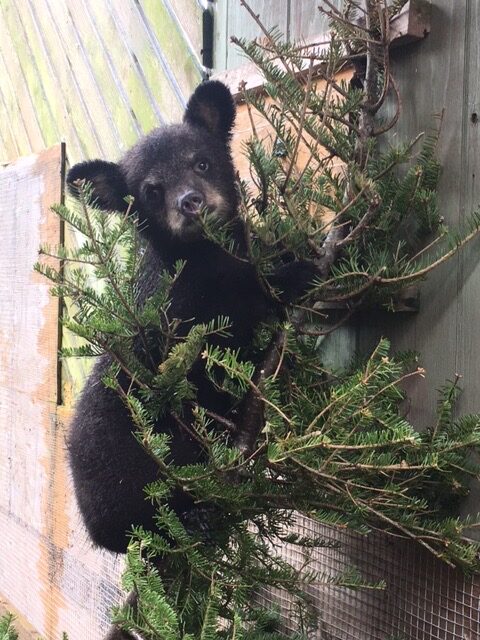
caption
A bear cub climbs a tree in a Hope for Wildlife enclosure. The organization is building a black bear rehabilitation centre in Cape Breton.Nova Scotia’s first black bear rehabilitation centre is slated to open in Cape Breton this spring.
Hope Swinimer, the founder of Hope for Wildlife, has been working towards this goal for 25 years.
When Swinimer received the news that the Department of Natural Resources is willing to work with her for this project, she said she “couldn’t be happier.”
“Getting this permission and being able to do it legally, and properly and setting up the proper enclosure is incredibly important,” said Swinimer. “We need to send the message that all wildlife is connected, it’s all important.”
Hope for Wildlife, a wildlife rehabilitation organization, has cared for a few black bears in the past brought to them by the Department of Natural Resources. Having a dedicated facility for black bears would allow them to give them special care.
Andrew Boyne, the province’s natural resources director of wildlife, confirmed the province supports the project. They’ve been working with Hope for Wildlife toward issuing a permit.
“We’re waiting for Hope for Wildlife to present us with a design for their facility, which we will approve in principle,” he said. “Then they will need to construct their facility, which we will then inspect.”
In addition to rehabilitating animals, Hope for Wildlife advances research and collects important data.
“Because we see so many animals, we can collect some amazing data for the government, for the community, for farmers, you name it,” said Swinimer.
So far, Swinimer has secured 100 acres of land in Cape Breton to build the rehabilitation centre. It will be at an undisclosed location that will be off-limits to humans, except for a few employees.
The habitat will include pools for the bears to swim, things for them to climb and plenty of natural space. It will also have strong fencing, camera systems and feeding chutes.
The centre would mainly take in injured, sick bears and orphaned bear cubs. The first phase of the bears’ rehabilitation will be monitored inside and then they’ll have access to a smaller outside unit. As they grow and progress, they’ll move into the larger unit.
“It will have to encompass all the different stages of development for the black bears,” said Swinimer. “I’ve gone to visit a lot of black bear rehabs and I’ve learnt from some of the best people that do it so we have a good solid base of knowledge.”
Some Hope for Wildlife staff members have also worked with black bears before.
The organization has raised about 25 per cent of the money it will need for this project. The centre will open regardless this year. Swinimer said the community has been generous with donations.
“There’s a lot of awareness out there and a lot of desire, people want to make this happen for Nova Scotia,” said Swimimer. “So we’re very very grateful.”
The rehabilitation centre will also represent a chance to collect data on black bears.
“You know we really get to see what’s happening in our natural world and we have that wonderful opportunity to study and learn.”
About the author

Emily Conohan
Emily Conohan is a fourth-year journalism student from Cape Breton.