
Safe Harbour
caption
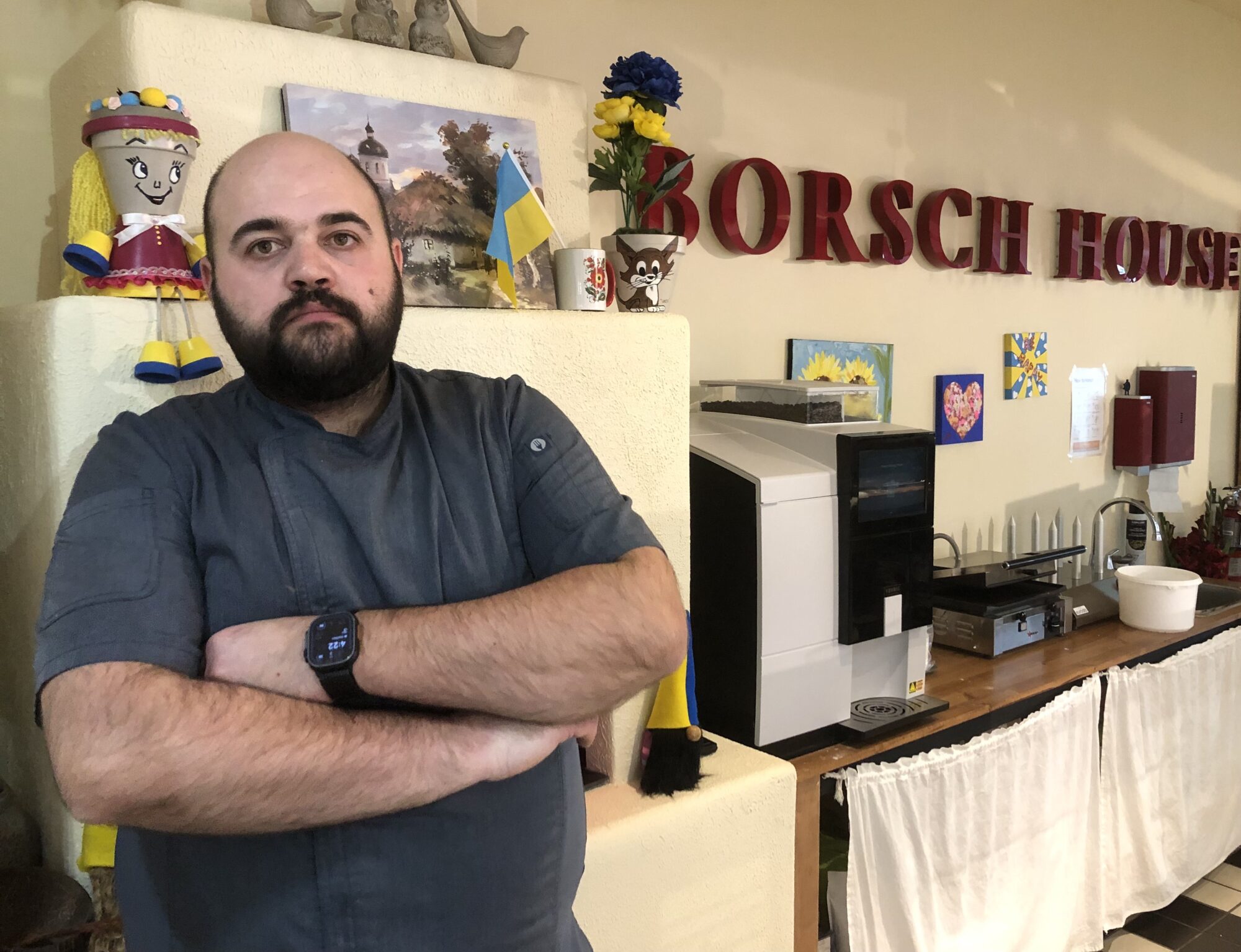
Yurii Shevstiv heads up the kitchen at Borsch House.He can’t understand why cigarettes are so expensive here. Why do Pall Malls cost more than $20? Back home, he smoked Lucky Strikes. A strong cigarette, very strong – which he likes – but you can’t find them here. Now, he smokes cheap, untaxed cigarettes meant for sale on Indigenous reservations. Between his massive fingers, a cigarette looks like a toothpick.
The city bus is puzzling. Back home, bus routes are run by private companies competing to pick up fares. At rush hour, rival drivers sometimes come to blows. He used to ride buses so crowded with old ladies and students and stevedores that as they left the station limbs would be hanging out open doors. Here, people move to the back of the bus and give up their seats to the elderly. Incredibly, some even thank the driver.
And why are there so many different English words for the loo? Seven years ago, before coming here, he worked in an Oregon fish-packing plant. Arriving there, he didn’t speak a word of English. (On his first day, when his boss told him, “Thank you Yurii, come back at six o’ clock tomorrow,” he blinked dumbly. It took a cousin on speaker phone translating before he understood, all while his boss swore at him.) Soon he learned how to pronounce “restroom” and recognize it on signs. When he came to Canada, he looked everywhere for a restroom but was confused to find only washrooms and bathrooms. Back home, a toilet is a toilet.
Yes, 33-year-old Yurii Yuryevich Shevstiv, who came to Canada in January 2023, often feels out of place.
He might not be alone in feeling that way: what must locals think of this Ukrainian man who spends his days and nights in the basement of a Halifax shopping mall? Yurii has been head chef at Borsch House (written per the Ukrainian spelling, without a finishing ‘t’) since it opened in February. The restaurant shares a food court with two Chinese noodle places and a Korean photo studio, all bathed in dentist-office lighting.
Locals may pay little mind to this stranger and his cafeteria-style restaurant. Or they might hear of it, come downstairs, and be puzzled by the translation errors on the menu. On a shelf in the small grocery store attached to Borsch House, nestled between tinned sprats and chicken jerky, sits a plastic baggie of dried mackerel alarmingly labelled “minke whale.”
caption
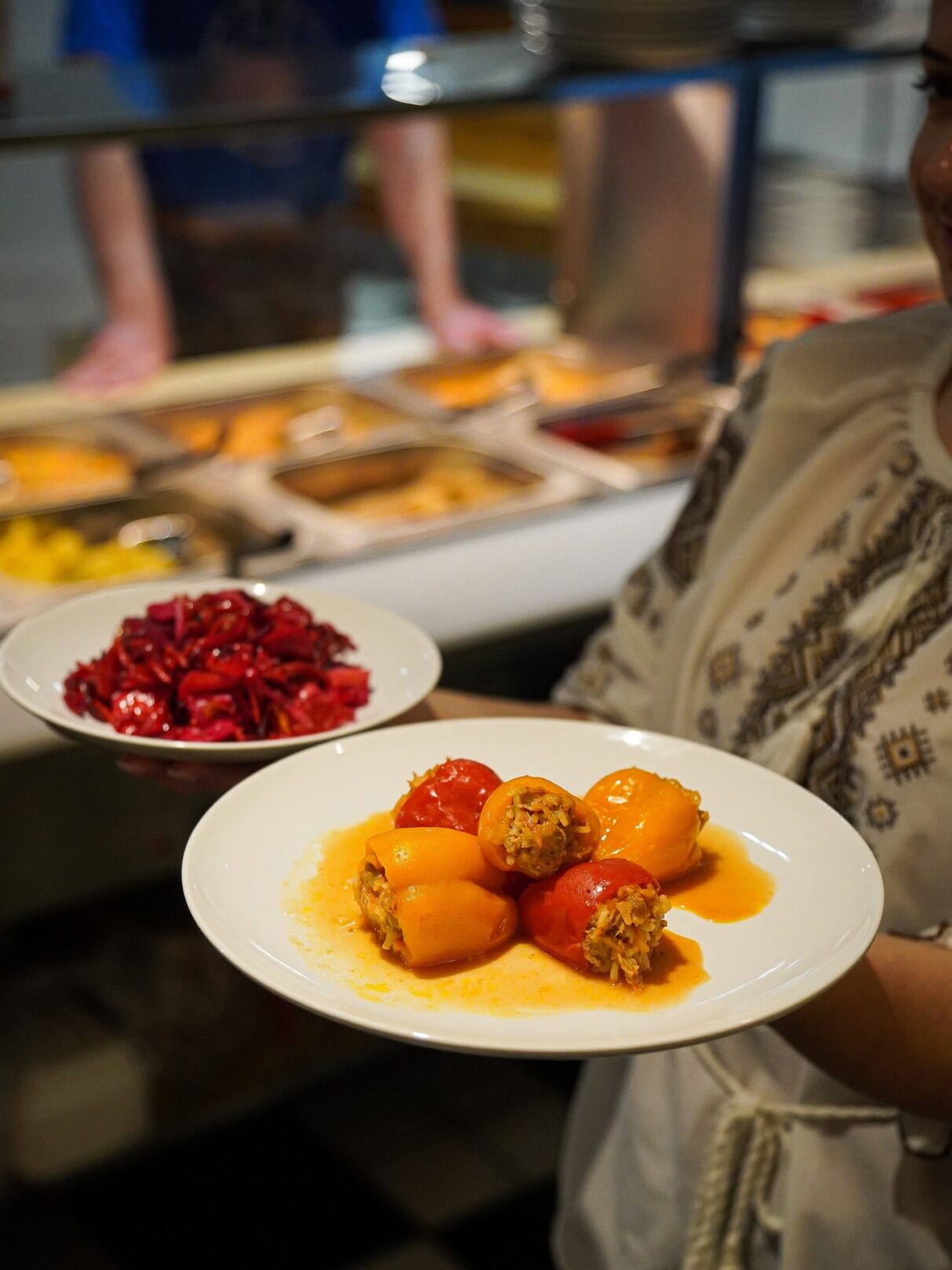
Hot stuffed peppers and cold beet salad at the Borsch House.Borsch House
Yurii delicately slides the knife through the thickest part of the chicken breast. He chops the cutlets into smaller pieces, adds them to a bowl with salt, pepper, oil, and paprika, and massages them gently. On the stovetop he adds them to a pot with onions and peppers, stirring to prevent anything burning. He wipes the sweat from his brow with the back of his hand and dries it on his black chef’s jacket.
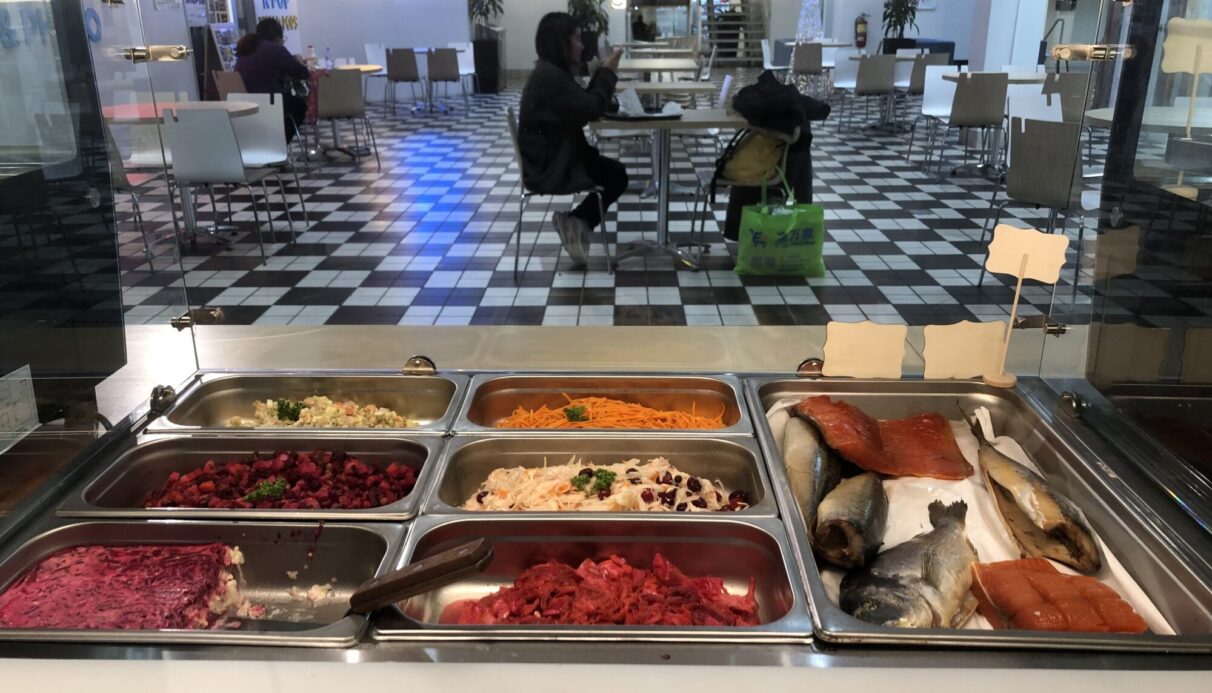
It is Thursday at 8 a.m., three hours before Borsch House opens, and the busiest time of Yurii’s week. Cold-smoked salmon and mackerel, steaming hot Chicken Kyiv, boiled potatoes with dill, pork and rice-stuffed peppers, eclairs garnished with pistachios, and of course, borscht: at 11 a.m. a truck will arrive to collect 80 kilograms of food. Borsch House is owned by Soika – a Ukrainian grocery chain that opened in 2024 – and Yurii cooks for both of its Halifax locations. (There’s a third Soika in Charlottetown, and a Moncton location opening in 2026).
Like many Ukrainians, Yurii’s first language is Russian and his English is very poor. His staff of five – all women – speak Ukrainian, which he understands well.
Yurii sprinkles mozzarella over individually packaged stroganoff casseroles. He is almost entirely bald, with a closely trimmed black beard and thick eyebrows. Standing over his chef’s station, with long legs and square shoulders, he looms like a Sasquatch at a dress parade. He walks stiffly, marching in large strides without swinging his arms. Yet for a large man in a kitchen he works with a certain grace. Ten years in restaurants will do that. And although he rarely smiles as he cooks, he has playful, mischievous eyes; bright brown, they reveal a youthful desire to prank and jest. But you would be forgiven for not noticing them above his dramatic eye bags.
Before opening, when the food court’s only visitors are elderly members of a local running club, Yurii and his team blast ABBA and Ukrainian pop. They work quickly, music echoing over the empty chairs. Borsch House isn’t even open, and Yurii has already done what many would consider a full day’s work.
Mondays are his favourite, because they’re his one day off. He usually works more than 70 hours a week, yes, but he has other things to attend to. It’s hard work being a refugee.
caption
Yurii’s cold table offerings in the food court at Spring Garden Place.Smoke break
Yurii mutters in Russian to a cook, Nadia. It’s 8:30 a.m., time for the day’s first smoke break. They put on their jackets, cross the food court and step into the brisk November air. They smoke in silence.
Life here is not easy. Yurii works 10 or 11 hour days and usually won’t clock off until after 8 p.m. On Sundays his wife Hana closes, while Yurii picks up their eight-year-old daughter, Mariia, from art class. When the weather’s nice, the two of them might sit in a park. Once, they drove to a farm in nearby Hammonds Plains to pet baby goats.
Yurii is busier than ever, but Borsch House is not. Most people in the food court come for Chinese noodles. A horde of high schoolers descends on the mall for lunch, but they bring packed meals or eat nearby fast food, not Yurii’s. He has a few regulars – most of them fellow Ukrainian newcomers – but business is slow.
“We could use some PR,” Yurii admits.
Managing a restaurant in this new place has taken its toll. He’s gained almost 50 pounds in the last two years, and smokes more than ever, up to a pack a day. When asked how the restaurant is doing, he has a habit of averting his eyes; he shrugs, takes a long drag of his cigarette, and looks down. “So-so,” he says. “Normal. There are good days, and there are bad.”
Yurii raises his shoulders to his ears as the wind picks up, shivering beneath his black parka and toque. There are worse places to be than the basement of a shopping mall.
Seven thousand kilometers away, drones circle the sky above his hometown.
The capital of humour
The land that is today Odesa has been inhabited for thousands of years. Once an Ancient Greek trading post, it belonged to the Ottoman Turks by the 16th century. After Catherine the Great of Russia conquered southern Ukraine in 1792, she decreed the small port be expanded and a city founded. By the late 19th century, the city had become extremely diverse, with large Jewish, Greek, and Italian communities. Poet Alexander Pushkin called it a city where “the air is filled with all Europe,” while Mark Twain considered it “one of the great cities of the Old World.” In the 20th century, the city became a vital economic hub as a port for exporting grain across the Black Sea, through the Mediterranean, and across the world.
Odesans love their city. They love its diversity (more than 133 nationalities call it home), its architecture, its nightclubs and beaches, and of course, its food. A famously lively bunch, they laugh frequently, drink heavily, and eat heartily. The local comedy festival is so famous, their town has been nicknamed “the capital of humour.” Most speak Russian, often loudly. And they affectionately call their city “Odesa Mama” – Mother Odesa, the matriarchal goddess of smoked fish, cold beer, and industrial freight shipping.
Although he grew up 70 kilometers north of the city in the village of Znamianka, Yurii’s a true Odesan. He loves that town. He first moved there to study agricultural science at the prestigious Odesa National University of Technology but began working in restaurants and started a family. Life was stable, normal, and pleasant.
At around 5 a.m. on February 24, 2022, Yurii and his wife were woken up by a loud bang that shook his apartment. They were confused – there had been rumours of invasion, but like many people, they didn’t believe them. Ignoring the explosion, he got up and took the bus to work like normal. Later that day, a Russian missile struck near his apartment while his wife and daughter were out on a walk.
The next two weeks were a blur. He took his family back to Znamianka for safety. There, in his childhood home, the reality of the situation set in: he had to do anything to get the three of them out of Ukraine.
On that first day, Russian missiles killed 18 people in the capital of humour.
1855, revisited
On a bitterly cold Saturday night, Yurii agrees to a to a walk from Borsch House, down Spring Garden Road, to Halifax’s Old Burying Ground. The historic cemetery, the last resting place of more than 12,000 people, has the only North American monument to a war fought close to Yurii’s hometown. A marble arch commemorates two Halifax men killed in the Crimean War in 1855. They died fighting for the British against the Russians.
In 2014, Russia returned to Crimea – and annexed Sevastopol from Ukraine.
Yurii is unimpressed by the monument. He loves Odesa and misses home, but he’s never cared much for the machinations of governments. He finds the idea of holding a gun terrifying. In the first few weeks of the Russian invasion, he volunteered as a cook for the military. Now he is in Halifax. “I’m a regular guy,” he says, burying his hands in his pockets and leaning forward into the wind. “I just don’t want to kill people.”
So Yurii left to meet his wife and daughter in Bucharest, Romania (they had already been out of the country for weeks). Under the Canada-Ukraine Authorization for Emergency Travel plan, he qualified for a three-year open work visa. While in Bucharest he found an apartment in downtown Halifax and a job in Dartmouth at a plastic bag factory. The family, grateful, moved here.
caption
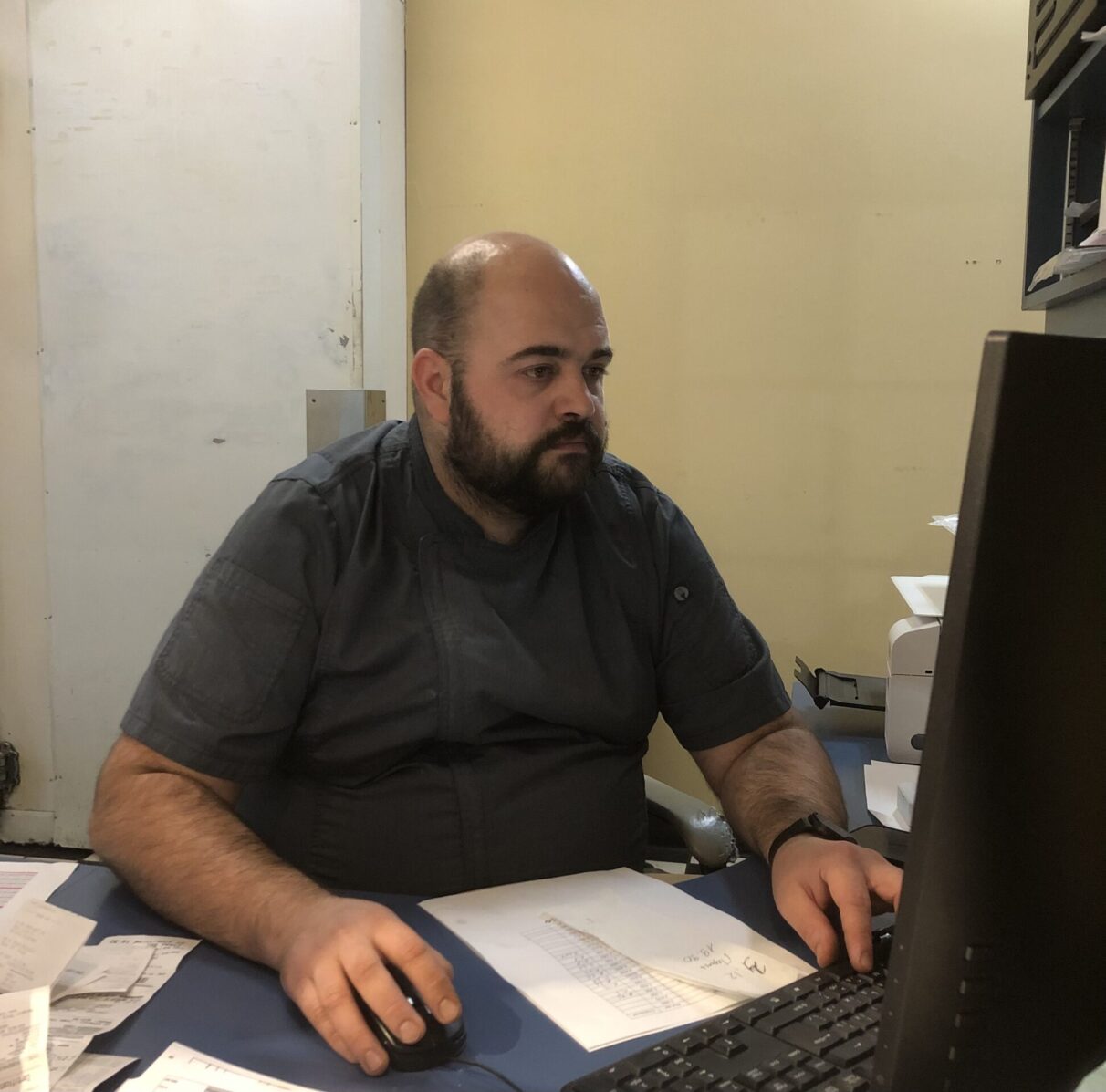
Yurii’s long days include managing the restaurant and creating monthly inventories, as well as cooking.Sunday
It’s Sunday morning and Yurii’s at work earlier than usual to prepare the monthly inventory. Today, the hot table will serve piping hot chicken cutlets and pork schnitzel, cooked buckwheat, cold beet salad, and cabbage rolls simmering in smoky orange oil, with freshly-baked profiteroles and cakes for dessert. He sits at a computer in the restaurant’s office and sighs heavily, occasionally checking his TikTok. He thinks of his daughter, of Mariia. He’ll pick her up from art class later today. If the weather was warmer, they might sit in the Public Gardens and watch the ducks. But it’s winter in Halifax, so they’ll probably stay home, Yurii scrolling on his phone and she on her tablet.
Yurii crosses the kitchen towards the walk-in freezer, passing beneath scraps of colourful latex dangling from a ceiling light. They are remnants from his birthday party in September. Back home, a birthday meant the whole village in one room. The burden of keeping everyone entertained, well-fed, and properly drunk falls to the birthday boy; in Ukraine, you cook for your own party.
He misses that sort of thing.
His employees tried their best. They were all waiting for him that morning with balloons and dollar store party hats. They shouted “surprise!” and sang for him in Ukrainian. Yurii cooked, and all six of them ate together around a small table. Afterwards, they presented him with a gift card to the Halifax Shopping Centre. The celebration was a reminder that life isn’t the same here, and might never be.
But Yurii thinks of his daughter: eight years old, almost half her life lived with her homeland at war. Her only schooling has been in Canada. By now, her English is better than both her Russian and Ukrainian. Not perfect, but then no one mocks imperfect English here. And it’s unlikely she’ll ever have to shelter from missiles.
Besides, Odesa will never be the same – even if the war ended tomorrow. And Yurii has changed too. He’s learned the meaning of “washroom” and grown accustomed to polite buses. For him, there’s no going back.


Leave a Reply