
AI-generated story pitches drive changes to freelance markets
Open invitations for stories disappear as generative-AI fools too many editors
AI-generated pitches from bad actors posing as journalists and seeking a payout have tricked editors around the world. This new form of plagiarism is easy to use, free and only a click away.
Open-calls for pitches used to be a great way for editors to find new talent. Just a handful of years ago, a simple post on social media could attract up-and-coming freelancers, all vying for a spot on the front page.
In an AI-centric world, open calls land editors in a dumping ground for AI-generated slop.
“Those pitch call-outs are immediately taken up by people using AI, and your inbox is inundated with bullshit,” says Nicholas Hune-Brown, executive editor at The Local, a Toronto-based online magazine.
In November 2025, Hune-Brown investigated a scam journalist. After putting out an open call for pitches, a woman who wrote by the name Victoria Goldiee, pitched him a story. After Googling her, he discovered her extensive backlist, having written for publishers including The Globe and Mail. Her pitch implied she had conducted interviews already, leaving Hune-Brown skeptical, as freelancers do not often conduct extensive reporting without a confirmed paycheque.
After some research, check-ins with interviewees she had quoted in previous stories and a short phone call with Goldiee, Hune-Brown confirmed his suspicions and reported she was using generative AI to write her stories.
Hune-Brown says he has not conducted an open call for pitches since.
“You can’t just blast Twitter, ‘Give me your best pitch,’ and expect to receive anything useful,” says Hune-Brown. “And maybe that’s been true for a little while anyway, but this has solidified it for sure.”
The Globe, The Guardian, The Walrus and Business Insider are among many who have been deceived by the faux-journalists scam.
Face-to-face connections are becoming a key way for freelancers to write for new publishers. Hune-Brown explains these offline meetings are helping him find new voices. “We’re trying to reach out to newer writers. I’m having a lot more coffees,” says Hune-Brown.
“There is no longer any intrinsic tie between the person sending the email and the words on that page,” he says. “You can no longer trust that.”
Matt Stickland, founding editor of Grand Parade, a Halifax-based newspaper covering city hall, says making an in-person connection is one way freelancers can excel.
“If you know the editor you’re pitching is always at city hall meetings, go to city hall meetings and see if you can see them in person.”
“Community happens when we run into each other,” says Stickland. “Whatever this large language model hellscape we’re entering, the human is going to become incredibly valuable; being weird is human.”
Matthew Townsend, editor at the South Dartmouth Post, explains he is sending journalists to events, asking questions to politicians and having a presence in the community.
“I’m trying to run a publication from 1970, in just about every way,” he says.
“A large language model doesn’t have much of a place in that.”
Now, freelancers need more than a strong pitch to stand out. Hune-Brown says it is easy for AI to replicate beautiful sentences and interesting narratives, making transparency, networking and agility crucial talents for freelance journalists.
While AI can support journalists with a long list of efficiencies, including transcription, filtering through data, and finding information on the Statistics Canada website, concerns are mounting over the impact of generative-AI on journalism.
“There are lots of interesting questions about how you can use it responsibly, how it can create good journalism. I do think it’s dwarfed by the simple business fact of artificial intelligence destroying the industry,” says Hune-Brown.
Generative AI is known to produce misleading information, presented as fact. Journalists who use AI to generate ideas, rephrase writing or conduct research without verifying accuracy, risk publishing fiction in a news costume. Without public trust, journalists are left reporting to an empty house.
“Most of the people that I’m connected with are creative and are therefore concerned they will lose work to AI,” says Townsend from the South Dartmouth Post.
“That the overall quality of work across society will decline, which I think we can see in a number of places.”
AI-generated media is gaining speed among readers. Stickland says if it is a numbers and clicks game, AI will win. “It is so demoralizing being a journalist right now.”
Matt Frehner, managing editor, products and platforms at The Globe and Mail, says journalists need to double-check everything AI outputs by confirming it against the original source, because AI is prone to what are known as hallucinations, or when AI confidently presents fabricated information.
“AI is not used for writing in the newsroom,” says Frehner. “It’s not used for editing and substantive work with copy at all, because that is the core function of the journalists in the newsroom.”
News agencies in Canada have been building their own set of AI guardrails, to draw a clear line between accuracy and efficiency. For freelance journalists, these guidelines are their touchstone.
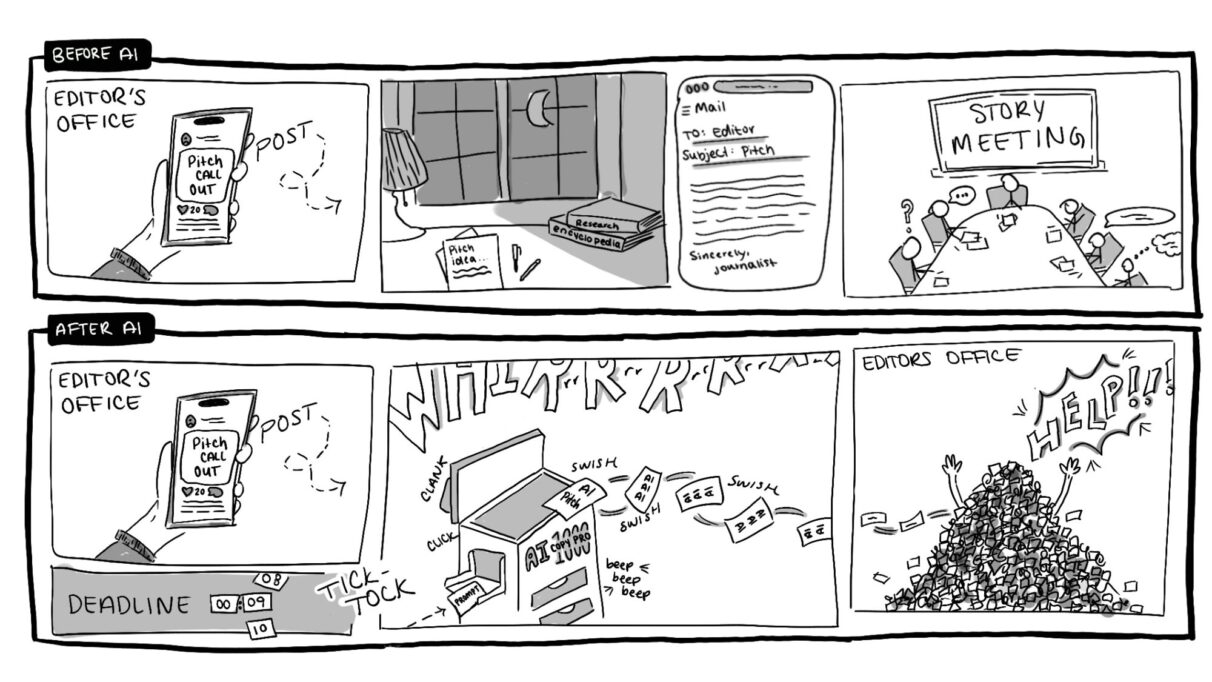
caption
An illustration that shows the before and after of generative-AI on open-call pitching.The Globe first published its AI guardrails in June 2023. ChatGPT, the first mainstream AI chatbot using large language models (LLMs), was released in November 2022. Frehner has to regularly update The Globe’s guardrails as AI-powered tools gain popularity.
“The tools are changing so quickly; the industry is changing so quickly,” he said.
“Every month there’s a new model or a new way to use AI, and we need to keep on top of what those are and how they interact with our journalism.”
The Reuters Institute, based in England, conducted a public survey in 2025 to understand how news is being consumed around the world. Twelve per cent of respondents said they are comfortable with fully AI-generated news, compared to 62 per cent with journalism produced entirely by humans. Their 2026 Digital News Report did not measure comfort with AI-generated news.
In many newsrooms, including at The Globe, AI can be used to transcribe interviews, as a research tool and to analyze public information. The journalist is still responsible for fact-checking AI outputs and disclosing their use of AI tools to their editor.
“(AI is) like a superpowered Google,” says Frehner, “. . . a superpowered researcher that can help you find the information you need . . . If you structure your prompts in the right way, you can get strong information back.”
Cape Breton-based freelance journalist Emily Latimer says she has been hesitant to use AI. Latimer has also worked as a freelance fact-checker, for Canadian publications including Maclean’s and The Globe and Mail.
“I’m not using AI at all because journalists are supposed to be talking to real people and doing their due diligence for verification and accuracy,” says Latimer.
Freelance journalists need publicized ethical guidelines on the use cases for AI tools in order to navigate their responsibility to balance veracity with productivity.
“The Globe sent me their updated AI policy and their editorial guidelines. It is important to keep up with everyone’s policies, but they are changing so often,” says Latimer. “If the editor wants me to know them, they have to send them to me.”
After submitting a pitch to The Globe, the editors’ role is to confirm if the journalist has used AI. Editors then share the AI guardrails to establish strict limitations on where it is allowed. This helps sift out AI-generated pitches.
“(It has) been a challenge for us, communicating those guidelines to freelancers and helping people outside the newsroom understand what it means to contribute to The Globe,” says Frehner.
The Globe’s AI guardrails have strict outlines on the use of AI in word processors, specifically forbidding Grammarly’s AI tools, Gemini in Google Docs and Copilot in Microsoft Word.
Frehner says he took care in ensuring the guidelines were clear.
The Globe’s freelance journalism AI guardrails state the following: “AI technology is increasingly integrated into everyday software. Be aware of any new features that might cross the line into generative AI. Use of AI plug-ins is also prohibited. For example, Grammarly has introduced an array of AI tools, and must not be used for editing or writing.”
“The danger is that by using an AI tool to rewrite, (it) strips the voice from the piece, it makes it less interesting, it makes it less authentic, it can introduce hallucinations,” says Frehner. “There are also ways that small subtle changes in grammar can change the point of view that the writer is trying to get across.”
The concern is centred around losing what journalism is all about — accurately representing the experiences of diverse communities.
“The stuff that we value is we’re doing reporting that you can’t find elsewhere,” says Hune-Brown.
“We’re writing those first-person narratives. I’m not interested in an AI’s opinion. We want it to reflect — and I think our readers want it to reflect — an actual person’s opinion.”
When asking about AI use, editors must believe, without a doubt, that the freelance journalist is telling the truth. Without trust, they risk contributing to misinformation.
“People pay for The Globe and Mail for the perspective of real human beings who’ve experienced real things,” says Frehner. “We break news. AI cannot break news.”
Hune-Brown said AI has introduced a chaotic level of misinformation that was not there a few years ago.
“It is destroying journalism,” he said. “They are the enemy.”

Leave a Reply