
Finding sanctuary
Building a whale sanctuary on Nova Scotia’s Eastern Shore proves complicated for government, community and environment
In 2019, Tammie Vautour was walking along the beach at Barachois Cove when she met Charles Vinick. Vautour, owner of Beanie’s Bistro in nearby Sherbrooke, is one of four residents that lives in the small community of Wine Harbour year-round.
Vautour has built her life around the coastline. It’s where she walks her dogs, picks berries, and finds artifacts. On her very first walk after moving to the area from Manitoba, she looked down and saw gold.
“This is my space,” she told Vinick, who was looking for a sheltered cove in which to build a whale sanctuary. Vautour wasn’t ready to give up her access. “This is where I walk my dogs. This is where I [pick] my cranberries,” she said.
“If you want your cranberries,” she recalls Vinick replying, “we’ll find you a faster way to go get your cranberries.”

On Oct. 21, 2025, Nova Scotia granted the Whale Sanctuary Project (WSP), an 83-hectare, 20-year Crown lease for land encompassing shoreline, a small island, and the seabed under Barachois Cove. The project site is about three hours east of Halifax, 15 kilometres south of Sherbrooke and along the shores of Wine Harbour.
Earlier that year, the project was at the centre of a bid to rehome 30 captive belugas at the now-shuttered Marineland Canada in Niagara Falls, Ont. When their request to rescue the belugas was denied, the organization turned instead to advocating for two orcas currently housed at Marineland Antibes in France.
Originally, the Department of Natural Resources required the project to secure unanimous consent from the landowners of nine bordering properties. For years, the WSP held meetings, ran public relations campaigns and exchanged tense emails with landowners and the Wine Harbour community, but could not secure full consent. On Oct. 10, 2025, then-minister of natural resources Tory Rushton lifted the unanimous consent requirement. Eleven days later, the province issued an order-in-council, authorizing the lease.
The project has become a flashpoint around rural economies, family identity, and environmental conservation. Despite opposition from some landowners, development is moving forward on the sanctuary. Late last month, adjacent landowner Boyd MacIsaac’s company, RJ MacIsaac Construction, was announced as the project’s general contractor.

Lori Marino and Charles Vinick first met at California’s Earth Island Institute a decade ago. “I always say that everything that makes life worth living for a dolphin or a whale is absent in an entertainment park,” said Marino, a neuroscientist and animal rights advocate. At the time, Marino was looking for someone who could help turn her idea —a seaside refuge for captive whales — into reality.
Vinick, known for his work to return the orca Keiko (made famous in the movie Free Willy) to the north Atlantic, was introduced to her as a potential partner in establishing the refuge. Soon after, they formed a non-profit, with Marino as president and founder and Vinick as executive director.
Planning the sanctuary started with finding somewhere to build it. In 2018, the pair found themselves swashbuckling through spruce, fir and birch along the shore of Nova Scotia, searching for a sheltered cove with deep waters.
“We’d get out and we’d go through the trees and try to get to the coastline to try to see what’s there,” said Marino.
They held town meetings from Liverpool to Cape Breton, and word of their search travelled faster than they did. Curious residents packed churches, fire halls, and Legion halls where Vinick and Marino made their pitch.
“We wanted to have a soft footprint,” said Marino. “And not go in there and cause problems for all the animals and the plants that lived in that area. Or the people.”
They laid out plans for a sanctuary that included a veterinary centre and observation tower. Reaction was mixed. Sheet Harbour residents told them to “get out of town,” Vinick remembers.
The site search continued until they reached Sherbrooke in 2019. “We would have never found the site, but for the people and the fishermen who took us there,” Vinick says now.
According to a Mi’kmaq ecological knowledge study conducted for the project, Barachois Cove was rich in lobster, trout, eel and mackerel for generations. When European settlers arrived, they built a small economy based on subsistence farming, fishing and logging.
But in 1861, Wine Harbour resident Katie Doody was walking along the shore when she spotted the first pieces of gold to be discovered in the region.
That year, men abandoned their farmsteads and started digging. Hundreds of new residents rushed the area, and Nova Scotia promoted Wine Harbour gold at the World’s Fair in Paris in 1900.
The industry started to fizzle by 1934, after producing 42,000 ounces of gold and sinking 300 mine shafts, and families left the town for better prospects. Mines were abandoned by industry as gaping holes in the earth.
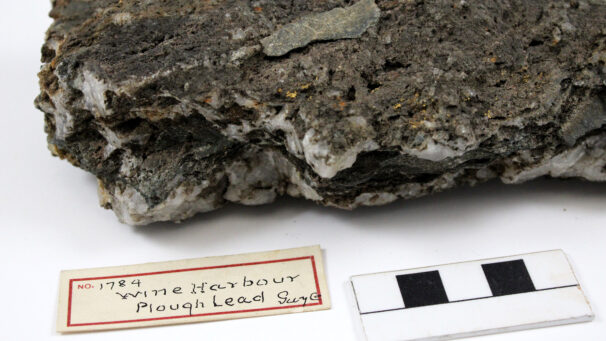
caption
Gold blebs in a quartz rock from Wine Harbour, photographed at the Nova Scotia Museum of Natural History. One of a number of gold samples displayed at the 1900 Paris Exhibition.Mary Burns, born in 1940, lived most of her life in Wine Harbour. She remembers playing around open mine shafts (called “open-cuts”) as a child, when kids ran across wood planks bridging 100-foot-deep openings. Russell McGrath, the son of a neighbouring family, fell into an open-cut beside his family home and drowned when he was only two years old.
“When I think about it now, I just cannot believe what we did,” she said. Years later, the property’s new owner filled the open-cut with truckloads of dirt, recalled Mary. “She said she just couldn’t abide by it being there.”
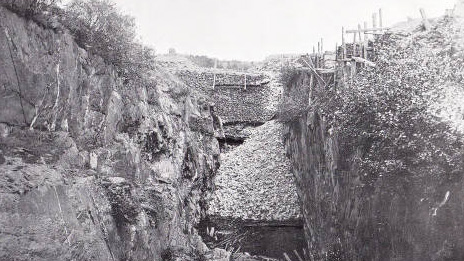
caption
“Open-cut” on the Plough Lead near the McGrath home, photographed during Wine Harbour’s gold rush.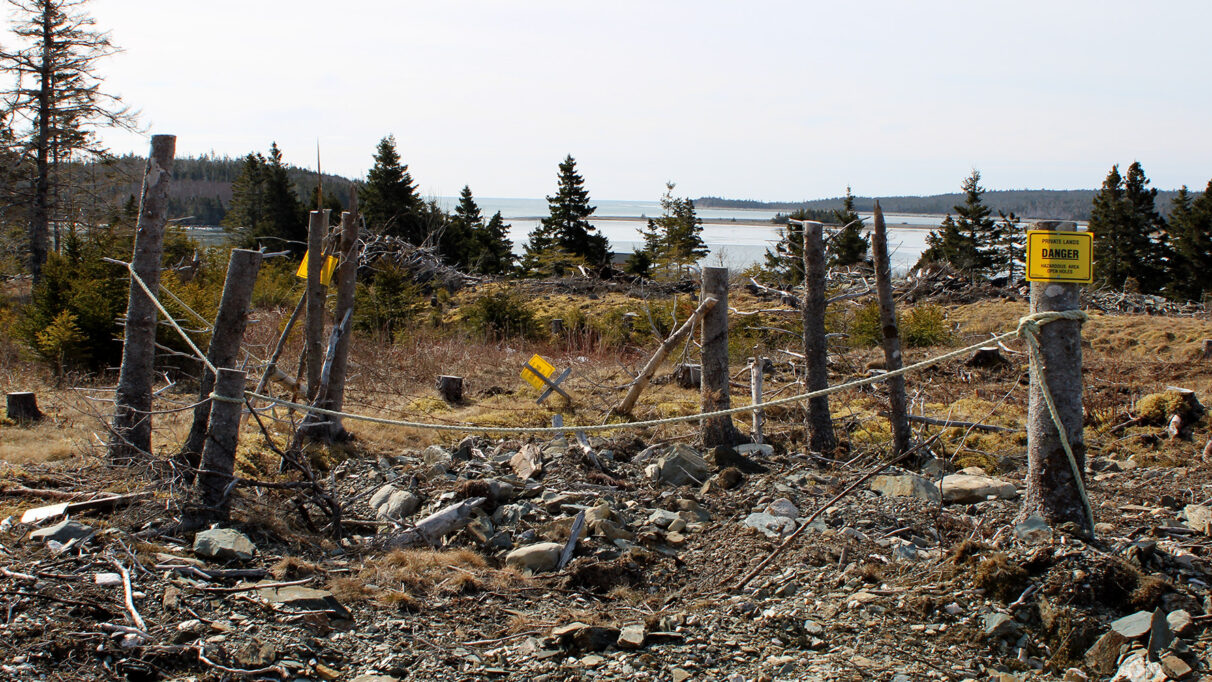
caption
Filled “open-cut” on the Plough Lead near the McGrath home in Wine Harbour, photographed in March 2026.Mary met her husband Graham on the school bus in the eighth grade. He became a fisherman off the wharf at Barachois Cove, and she picked blueberries and cranberries in the bush around the shore.
The two raised their daughters, Maureen and Tracy, in Wine Harbour. “Everybody had gold in their homes,” Mary said, describing how people collected tiny pieces of gold and called them “sights.”
“They’d have them [in] saucers on the windowsill… Graham always said, gold is where you find it.”
Fishing became the region’s economic mainstay. In the early 1960s, local fishermen dropped lobster traps into the waters surrounding Wine Harbour by hand.
“My uncle was one of them. He had arms on him like stove pipes,” said Hughie MacDonald, who has fished out of Wine Harbour for over 60 years.
MacDonald took up his uncle’s vocation and, through the Wine Harbour Wharf Society, he and Graham Burns built a wharf to dock their boats. That wharf juts into Barachois Cove and is located at the centre of the Whale Sanctuary Project’s proposed development.
“Graham always said, gold is where you find it.”
Mary Burns
In 2019, 50 people packed Sherbrooke’s fire hall for a meeting with the WSP, during which Vinick and Marino spoke about the sanctuary. In attendance was Amy Simon, a Sherbrooke resident and animal lover soon to become the WSP’s outreach co-ordinator.
“When you have people coming from away… into a community that depends on the fishing industry, it’s scary,” Simon said of the meeting. “So, it was definitely full of questions … Even with the level of skepticism, there was excitement that it hadn’t been done before.”
Vinick recalls after the meeting that Simon “literally wouldn’t let us leave town.”
When they returned to Sherbrooke three months later, Marino and Vinick were welcomed by signs — “Belugas Belong Here” — posted at the end of driveways and a 16-foot-long beluga billboard that Simon hand-painted.
She recalls telling Vinick, “You guys are going to come here or I’m going to die trying.”
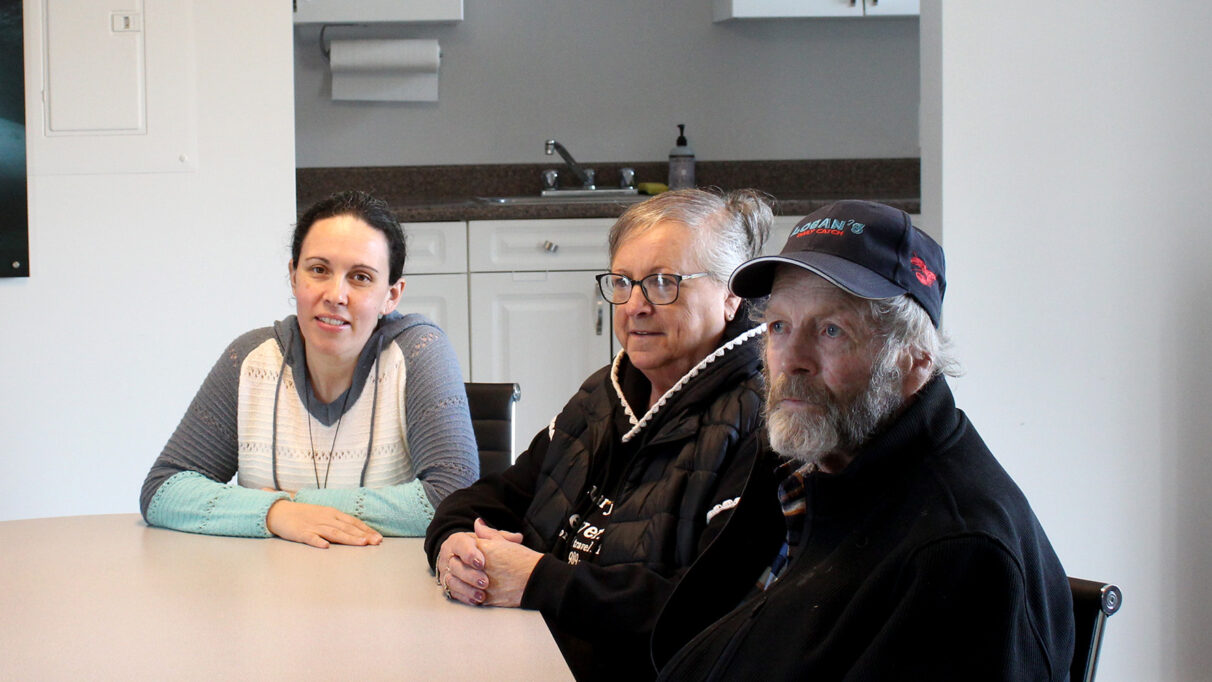
caption
Amy Simon, Helen and Hughie MacDonald sit in the Whale Sanctuary Project conference room in March 2026.Before the WSP officially announced the sanctuary site in February 2020, Simon took Vinick to meet with Hughie MacDonald and his wife, Helen.
Vinick pitched the project at the MacDonalds’ kitchen table, outlining how the nets of the bay pen would incorporate the wharf, blocking fishing operations. Despite this, MacDonald was on board.
“To have him look at me and say, ‘If it works for the whales and it works for the community, I’ll make it work.’ That’s huge. That doesn’t exist everywhere,” Simon said.
But consent was not entirely theirs to give — 18 years ago, Boyd MacIsaac, owner of RJ MacIsaac Construction, purchased the wharf from the Wine Harbour Wharf Society.
“We purchased the property and helped the Wine Harbour fishermen out. We cleaned it ourselves and allowed them to stay there for a period of time,” said MacIsaac in an interview in February.
Including the wharf, MacIsaac owns five of the nine parcels of land bordering the project site — acquiring his consent was key to the project’s development, and he was keen to grant it.
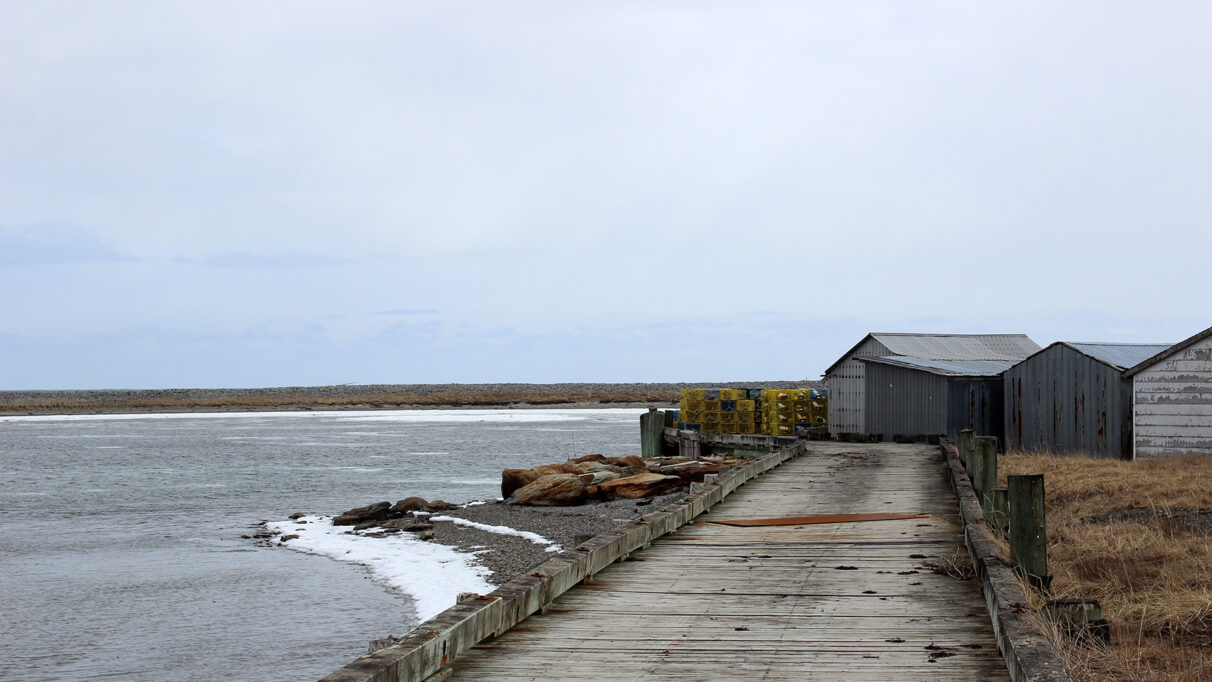
caption
The wharf at the centre of the Whale Sanctuary Project’s proposed development is currently owned by RJ MacIsaac Construction.The Burns family, however, had reservations. Their land borders the sanctuary site and includes the access point to a spit that connects Barachois Island to the mainland. In 2021, Vinick asked permission to use the Burns’ land by driving ATVs across it to access the spit and island.
“We weren’t right struck on the idea, only because we didn’t know anything about it,” said Maureen.
They were advised by a lawyer not to sign consent unless conditions were made, namely “that the property be restored if [damage] ever happened.”
In July 2022, Vinick again requested their consent for the project. He handed them a piece of paper that said, in essence, “I give consent to the Whale Sanctuary Project to use my property for the next 20 years,” explained Tracy. “With no details.”
The Burns’ asked to see the lease application and reiterated their desire to have project accountability written as a condition.
Before he left, they remember Vinick saying “you can put a stop to this project by not signing.”
Vinick then contacted the Department of Natural Resources to ask if a landowner could request a “quid pro quo” in exchange for consent. According to internal documents obtained by The Signal, the department responded, “a letter of consent cannot be conditional.” The Burns argue that their family didn’t ask for compensation.
Over the following months, Vinick continued emailing the family requesting their consent.
In September 2022, Vinick proposed limiting the number of vehicles and people that would access the site, to address the family’s concerns about traffic, from sanctuary staff and tourists, coming into Wine Harbour
On a late summer morning that same month, Maureen visited Sherbrooke’s farmers’ market. As she stopped to browse, she felt a presence behind her.
“I went to move away from the vendor and (Vinick) was right there,” she remembers. “I couldn’t really (move) either way.”
“Have you decided to sign the agreement?” she recalls him asking.
She said she was shocked that he would approach her there — she didn’t give him an answer that day and they haven’t spoken since. “We felt confident that this rule was in place,” said Tracy. “That they needed our consent. They have it on record, we’re not consenting.”
Boyd MacIsaac, however, requested to meet with the family in May 2024, in an attempt to get them on board with the project.
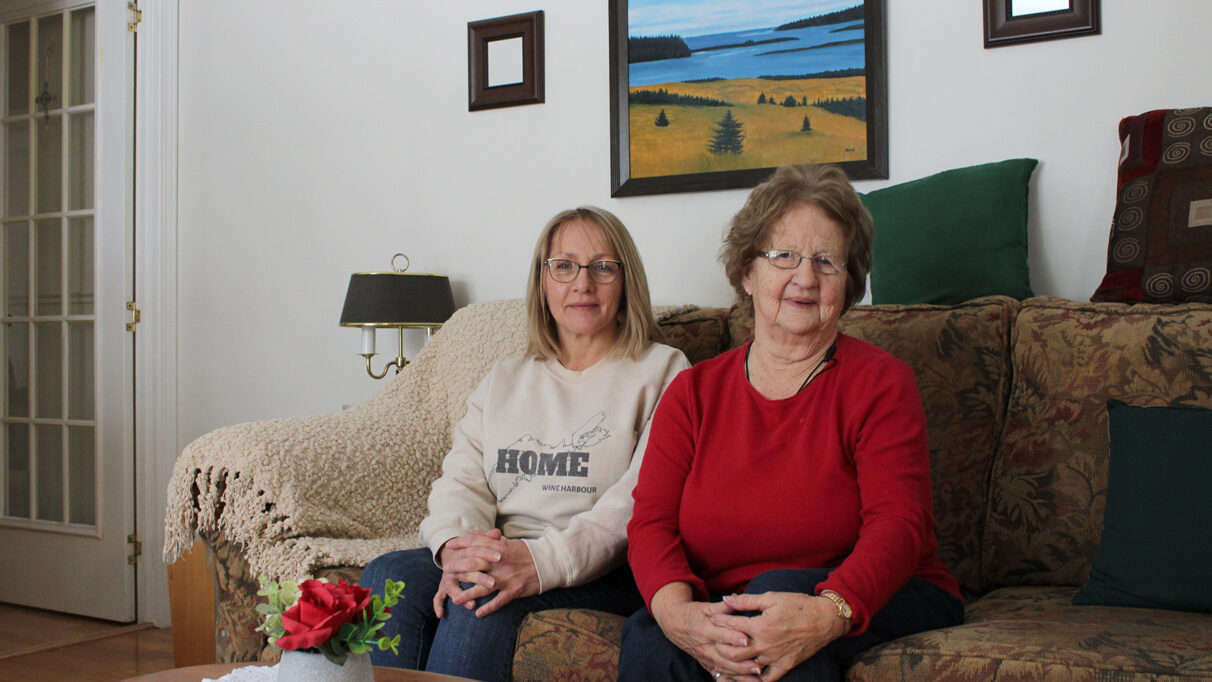
caption
Maureen Fraser and Mary Burns sit in the living room of Mary’s Sherbrooke home in February 2026.Apart from MacIsaac and the Burns family, WSP needed consent from the owners of three other parcels. One landowner, Donald Hewitt, lives in Alberta but has deep family ties to Wine Harbour. He declined to tell The Signal if he has consented but said that he wants to see more opportunities for the community. The other landowners, including former NHL player Ken Linseman, do not live on their land year-round and have not responded to interview requests.
When news broke that the unanimous consent guideline had been reversed, Tracy Burns posted to Facebook on Oct. 24, 2025, calling the action “unreasonable and unfair.
“Whale Sanctuary Project has taken advantage and pressured our government to break the rules,” she wrote. “They have pulled on the heart strings of Canadians, implying that this sanctuary could be the solution.”

Debate about building the whale sanctuary isn’t isolated to residents. Throughout the development process, the WSP has heard numerous concerns surrounding their plans.
The land and coastline in and around Wine Harbour is pockmarked with evidence of the area’s mining past. Decommissioned gold mines dot the project site, some of them marked only with fluorescent danger signs.
A report from the Geological Survey of Canada details “exceedingly high” levels of arsenic and mercury in soil and groundwater on the surrounding land and in the marine sediment of the project site.
Much of the contamination is in and around sites where companies dumped mine waste, or tailings, containing traces of arsenic and mercury left over from the mining process.
Over time, tailings have settled in a nearby pond and wetlands, sinking the contaminated sediment beneath surface levels.
If undisturbed, those tailings are relatively harmless. But once development starts, official risk assessments warn that disturbing the soil could contaminate the environment.
To contain the whales, WSP will need to anchor nets. ”There’s no contamination of soil” where the nets will be anchored, according to Vinick. He declined to share with The Signal the exact co-ordinates of where the anchors will be placed.
Before installing nets, the WSP needs approval from Transport Canada under the Navigable Waters Act, which Vinick said has “long since been completed.”
However, the department told The Signal in an email that approval has not been issued.
Additionally, the nets have to be ordered and fabricated, which Vinick said needs to happen this spring for installation in the summer.
The WSP also has plans to build a veterinary centre and other buildings on land that surveys indicate contain tailings. A risk assessment has found that developing on land could expose groundwater, well water and septic systems to dangerous levels of metals. Both Vinick and MacIsaac have signed an agreement acknowledging the risks posed to human and ecological health through developing the sanctuary.
While only two fishing outfits will be displaced from the wharf when the sanctuary is built, Ginny Boudreau, manager of the Guysborough County Inshore Fishermen’s Association, worries that this could cramp an already full fishing area.
“It may not seem like a large number of fishermen. But wherever those fishermen are displaced from, they have to go somewhere else (and) there’s already someone somewhere else,” said Boudreau.
“So, you’re not just taking access from a space on the water to fish, you’re also concentrating fishermen on top of each other to the west or the east. (…) That creates conflict.”

Paul Watson, founder of the Captain Paul Watson Foundation and Sea Shepherd Conservation Society, sees Nova Scotia as an unfit home for Wikie and Keijo — the two orcas the WSP currently hope to bring to the sanctuary in September 2026. The whales are held in Marineland Antibes.
Fisheries and Oceans Canada could not confirm status of the WSP’s application for an introduction and transfers licence, required for the release of marine mammals into fish habitat.
“The French government knows this, if they try to send the whales to Nova Scotia … we will sue them,” Watson said in March from his houseboat on the Seine.
“If they try to send the whales to Nova Scotia … we will sue them.”
Paul Watson
The Burns family remain opposed to the sanctuary being built in their hometown and dubious that the WSP can come up with the funding to get their project built. “We’re not against what they’re trying to do,” said Maureen. “I just don’t know that it’s the right people that are behind it, or the right spot. We’re looking down the road for our kids and our grandkids and how they’ll be able to enjoy Wine Harbour.”
To complete the sanctuary, the WSP estimates that it will cost around USD$15 million, which they plan to fund entirely through donations. Public records show that as of 2024, the WSP had $2 million in revenue. Vinick declined to comment on how much the organization has in pledges.
“Some of the (donors) we’re working with prefer to give funds … to whales than to dirt,” said Vinick in a 2025 St. Mary’s Municipality council meeting.
In a statement to The Signal, the Department of Natural Resources confirmed that, while the lease process is moving ahead, it has not yet been signed. Officials also noted that the department is not responsible for the project’s approval, only granting the lease itself.
Still, plans for development continue. The wharf in Wine Harbour is now blocked by fences with RJ MacIsaac Construction signage. After the company was announced as the project’s contractor, Vinick confirmed with The Signal that the WSP has plans to buy 30 acres of MacIsaac land surrounding the site.
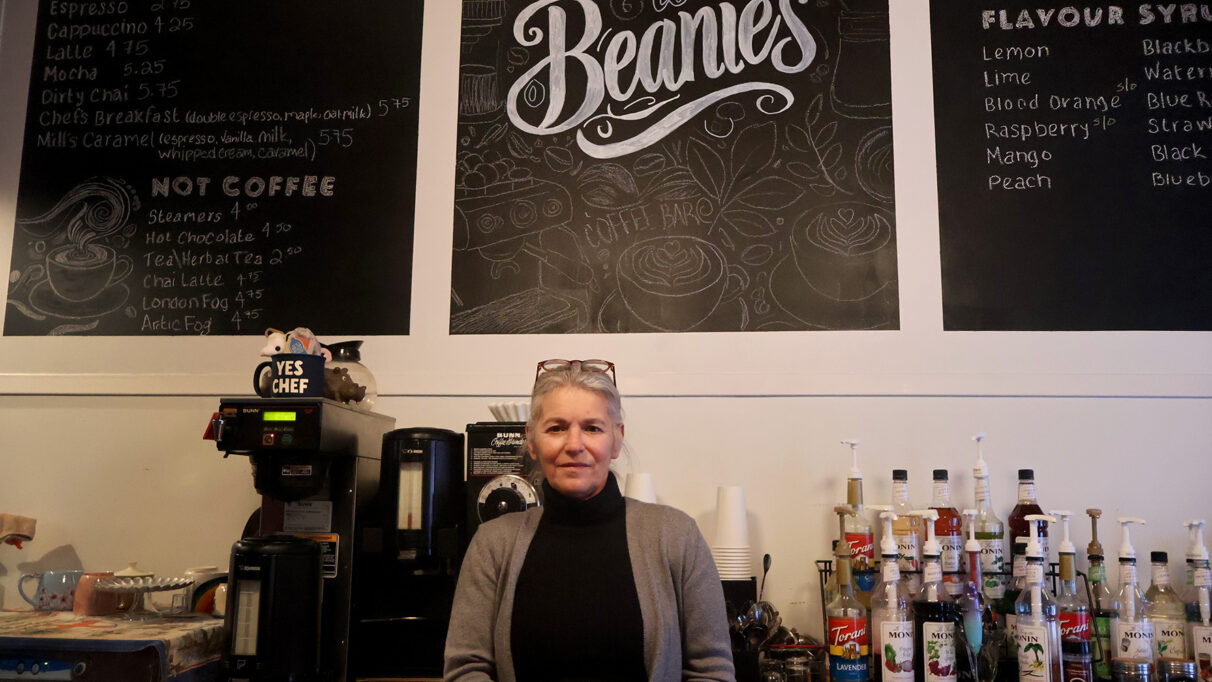
caption
Tammie Vautour stands behind the counter at Beanie’s Bistro in February 2026.Sitting at a table at her café in February, Tammie Vautour spoke of the opportunity WSP could bring to the region. As a tourism operator, she acknowledged that the Eastern Shore is at a tipping point.
“There is so much untapped potential here,” she said.
In April 2025, Vautour sent a letter to several government officials, including Premier Tim Houston and then-minister Tory Rushton.
“I’m not just a resident — I’m the person who uses and stewards the proposed site more than anyone else,” she wrote. “I hike the trails, paddle the shoreline, harvest sea salt, and walk my dogs daily through that land. I know every cove and rock by heart. It’s a rare day that I encounter another person there — yet I believe this sanctuary has the power to change our community for the better.”
“Things change,” Vautour said 10 months later. “It’s got to be in somebody’s backyard.”
About the author
Tedi Buffett
Tedi Buffett is a reporter for The Signal and a masters student at University of King's College.

Olivia Nitti
Olivia is a reporter at allNovaScotia and a journalism student at the University of King's College.

Leave a Reply