
From newsrooms to Zoom rooms: what remote work means for young journalists
caption
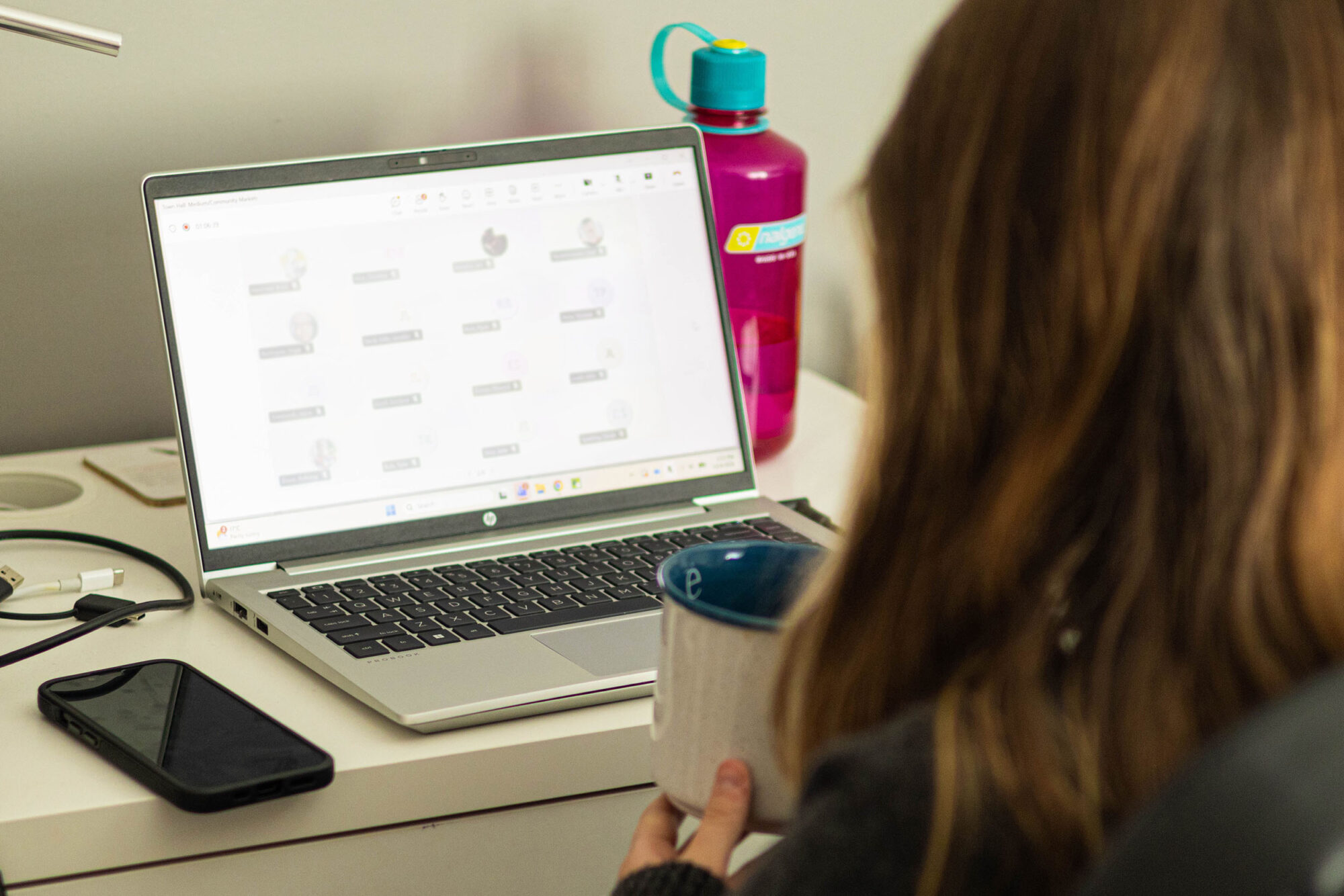
A young reporter attends the daily meeting while she sits at her desk and drinks her coffee on Thursday, Oct 8, 2026. Her bedroom is also used as an office space since she works from home every day.Journalists reflect on self-isolation of disappearing newsrooms
On a dreary Thursday morning, a 21-year-old journalist rolls out of bed in a major Canadian city to join her daily story meeting from her laptop, lamenting the loss of a newsroom she never got to experience.
Young journalists across Canada are living through a new age of journalism, one that does not include a routine commute to a bustling newsroom. Instead, they are confined to the walls of their own home, where they meet through screens.
Their ranks include one young journalist who spoke with The Signal, which withheld her identity as she began the first few months of her career. Her commute to work consisted of three steps from her bed to her desk, which are both situated in the same room: her bedroom.
“I sleep, I eat, I work, all in one room,” she told The Signal from her bedroom. “And then I go back to bed. And I wake up and do it all over again.”
The Signal interviewed the young journalist, in her home office, in autumn 2026.
She landed a five-week internship with a small CBC bureau before graduating from a Canadian journalism school in May 2026. The following month she took a summer internship with a second Canadian media outlet, and was offered a full-time position the following August.
She says working alongside the reporters at CBC gave her invaluable experience and a glimpse of what it was like to work at an in-person newsroom.
“I would be sent on assignments with my coworkers so that they could teach me how to gather and do certain things,” says the young work-from-home journalist.
She says the daily interactions with her co-workers made showing up to work easy, even if it was just the “car rides with people in the CBC car, where we could chat or listen to music.”
“I would walk in (to the office) and I would feel more motivated,” she says. “You just feel like you’re a part of something.”
The young journalist says one of the biggest struggles working online is feeling isolated from a team environment. Morning meetings are not as collaborative when you cannot see your colleagues’ faces.
“I have not met a single fellow reporter or any of my bosses,” said the reporter. “The only two people I’ve met are the two staff photographers that we have who will come with us to interviews or events. But otherwise, I haven’t met any of my fellow reporters.”
She says shifting to an online workspace has made it harder to get to know people on her team, which has instilled a hesitation to reach out to her co-workers for help or advice.
“I want to see how other reporters are handling those roadblocks,” she says. “Which I wouldn’t know unless I was watching them from across the newsroom.”
Melissa Stasiuk, the head of newsroom development at The Globe and Mail in Toronto, says she strives to build a collaborative culture in the newsroom, since the in-person space is “the heartbeat of a publication.”
“Our news meeting is kind of out in the open and so anybody is free to sort of drop by or listen in,” Stasiuk told The Signal over the phone. “Those interactions are just so valuable to any journalist, but especially young, (and) early career journalists.”
Stasiuk started at The Globe and Mail over 20 years ago and worked in various positions before taking on her current role on the masthead in January 2024. Stasiuk manages the hiring and training process, and overall newsroom strategies, which she says is focused on creating learning opportunities for everyone.
“We have two . . . main programs that are focused on early career journalists and that’s our summer program and our academic intern program,” says Stasiuk. “it’s very heavy on . . . learning from different editors and reporters in the newsrooms.”
Interns are paired with mentors, she says, and they host weekly training sessions in the office for anyone to attend.
“Having a regular schedule of in-person events, . . . to foster that sense of like, ‘Oh yeah, it’s worth coming into the newsroom,’ ” she says. “You never know who you’re going to run into at those types of sessions and what kinds of conversations you might have when those sessions are over.”
Stasiuk says the daily interactions make showing up to work more enjoyable.
Susan Clairmont, a seasoned investigative reporter and columnist with The Hamilton Spectator, says when she works in a newsroom, she spends a portion of every day mentoring the younger people she works with.
“I am one of the most senior people there,” Clairmont tells The Signal on a Zoom call. “I see it as my role to teach.”
Clairmont has worked with The Hamilton Spectator, also known as The Spec, for almost 30 years and has encountered a whirlwind of changes in the newsroom. Between 1976 and 2020, The Spec operated out of a large, three-storey, brick building in downtown Hamilton that housed a printing press in the basement and a massive newsroom on the third floor.
“When I walked into The Hamilton Spectator for the first time, I was stunned at how huge it was,” says Clairmont, whose previous newsroom experience was with the much smaller Peterborough Examiner.
Clairmont says the newsroom quickly became her life, and she sometimes spent more time in the office than she did at her own home. The collaboration she had with her co-workers during those long hours, she says, helped foster a sense of community and made for better teamwork.
In March 2020, when COVID-19 sent everyone to work from home, The Spec had to adjust to working as a remote newsroom. Not long afterward, the building was sold.
According to the Local News Research Project, 640 local news outlets have closed in 407 communities across Canada between 2008 and October 1, 2026. The map data also shows that out of 210 local news outlets launched between these years, 19 of them shifted to online publications.
The young work-from-home journalist says working in the CBC newsroom made her appreciate the presence of the building, which allowed the public to “picture us and (see) we’re not some floating entity in the cloud.”
“I remember at CBC, . . . people . . . would come up and knock on the doors,” she says. “A lot of times they like just had story ideas.”
She says the executive editor often greeted the public at the door, letting them know they were always welcome.
“It just becomes a part of the community.”
Phoebe Maares, a research fellow at the University of Tübingen in Germany, describes the newsroom as part of the journalistic identity in her co-authored paper about newsrooms as sites of community and identity. She says it is a space that fosters teamwork, builds self-esteem, and allows everyone to feel a sense of belonging.
For 26-year-old reporter Fallon Hewitt at The Spec, the newsroom did just that.
“There was always collaboration,” Hewitt told The Signal on a phone call, about her time with the Telegraph-Journal in New Brunswick. “People would come and sit at your desk. You could go to your editor, and they could edit your work in front of you and you could go through the changes.”
“It was just an ease of communication.”
Hewitt attended Humber College in Toronto and completed internships at Chatham Daily News and the Sarnia Observer through Postmedia after graduating in 2018. She says being a part of those newsrooms at the start of her career set her up for success.
“They helped guide me. They helped offer me assistance, pitches, assignments, and I could hear how other people were tackling things,” says Hewitt. “I wouldn’t have gotten that same level of mentorship (without a newsroom).”
She says neither of those newspapers have a newsroom anymore.
Clairmont says working from home drove her co-workers “into a culture where nobody phoned each other,” and messaging people for help was no longer reliable.
“If I’m in the newsroom, . . . I’m going to know what that person’s working on because I can hear what they’re working on,” says Clairmont.
“When I’m at home, it’s like, I see something in the paper and I go, oh, I had no idea they were doing that. I could have helped them out. And help them do an even better story.”
Online newsrooms do not give the young work-from-home journalist the same opportunities Hewitt and Clairmont received at the beginning of their career. Clairmont says working from home limited interactions with her peers, and isolation crept in faster than her own shadow.
“The journalism industry, . . . it’s hard. It’s really, really hard,” says Clairmont. “We’re being asked to do so much more with less and trying to keep up with technology . . . It’s a lot.”
As an investigative reporter, Clairmont regularly covers stories about murder, abuse and domestic violence, which takes a toll on her mental well-being.
“When nobody knows by the look on your face what kind of day you’ve had because nobody sees you, it’s on you to reach out (for help),” says Clairmont. “Working from home made me feel completely by myself.”
Clairmont and a few of her colleagues took it upon themselves last year to speak directly to Jordan Bitove, the owner of The Spec, to make a case for an in-person newsroom. He listened and managed to get them an office space in the CHCH building, about a 15-minute drive from downtown.
Clairmont says things have been much better since they moved to the new office last spring, but it still does not compare to their old building.
“Having the Spectator sign on the side of the building and having a place to walk into, that was . . . kind of the heartbeat of the community,” Cheryl Stepan, The Spec’s editor in chief told The Signal in a phone interview.
Stepan started at The Spec in 2000 as a daily reporter and says having that space for editors and reporters to come together “was something that was really special.”
“It was just a building, but it represented a lot more than that,” says Stepan. “It represented the journalism we were doing, and it was a place for us to gather and work on that journalism.”
“Not having that is definitely a loss.”
For the young work-from-home journalist, there is no sign at her workplace. She does not have colleagues to wave goodbye to or share a laugh with at the end of a workday. Instead, she closes her laptop, walks to her kitchen to heat up leftover dinner, and gets ready to do the whole thing over again within her bedroom walls.
Despite this isolation, she says she is still hopeful.
“When you’re alone in your room, you notice your bad habits so much more, and you notice what is prohibiting you from doing your best work,” she says, while pouring her fourth coffee of the day.
“I think I’m becoming a better worker and a better journalist by having to be self-disciplined.”
She says she has accepted the fact that an in-person newsroom may not be a part of her journalistic identity at this point in her career, but in-person reporting will always be.
“It doesn’t really matter if you’re going from your bedroom to go interview someone in person, and then going back to your bedroom to write the article,” she says. “I think it just matters that you’re there.”
About the author

Ainslie Nicholl-Penman
Ainslie is in her last year of the Bachelor of Journalism Honour's at the University of King's College. She stays involved on King's campus as...
Leave a Reply