
Keen on kelp? A sustainable business faces barriers
Environmentalists, researchers, producers work to grow industry from infant stages
caption
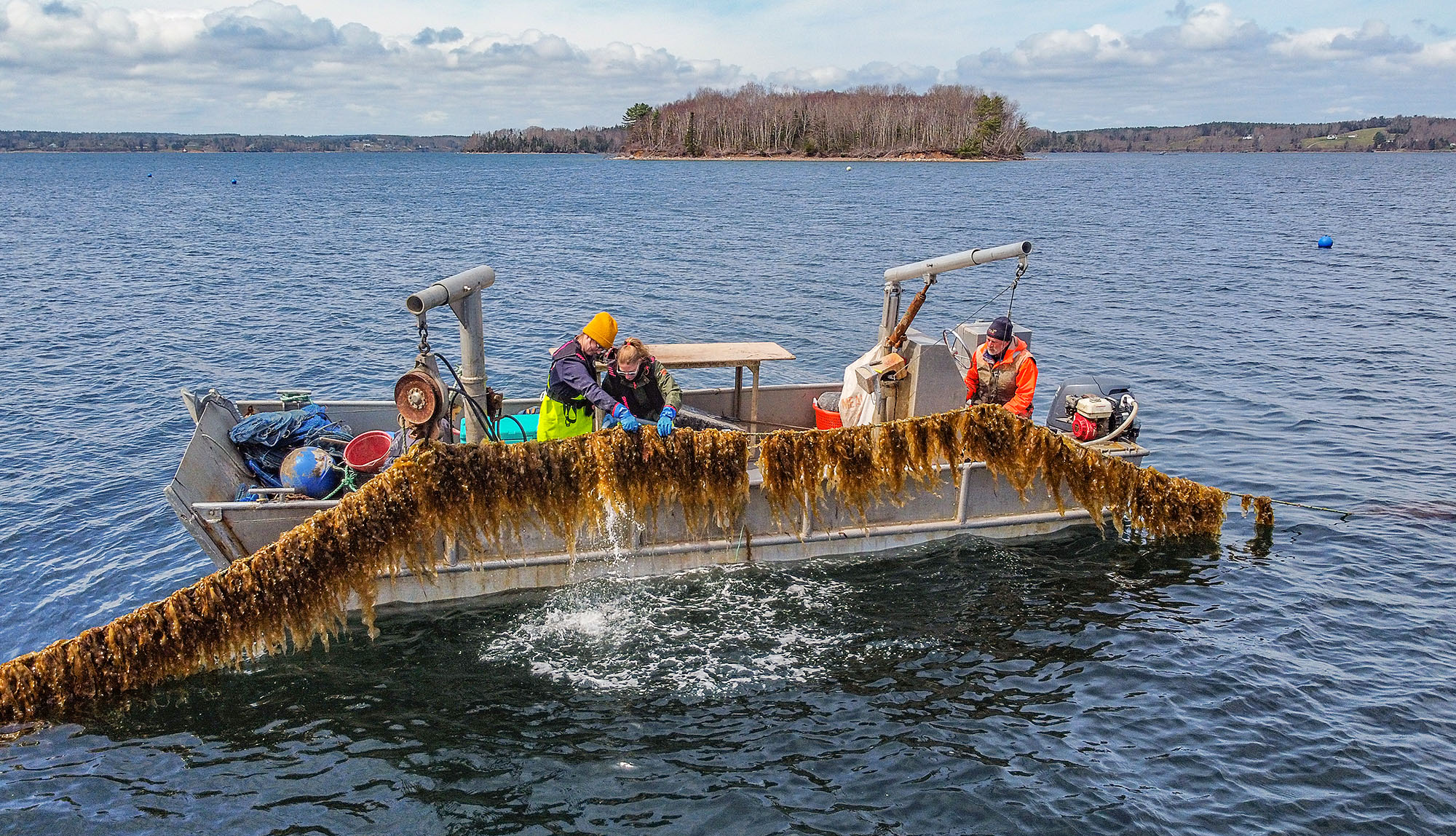
Kelp being farmed in Mahone Bay, Nova Scotia, in April 2023. Mahone Bay is one of many areas producing kelp in Nova Scotia.As with any new industry, kelp farming in Nova Scotia faces an array of challenges, but there is excitement about what could be a new path for economic growth in a green industry.
Kelp — a leathery, edible seaweed — can be used as food, fertilizer, or an additive in products such as face creams and beauty products. It is found naturally in Nova Scotia, and farming it produces high yields and has a low cost of production.
At the forefront of that excitement is the Ecology Action Centre. They plan to debut their 2026 market viability report for kelp farming at the upcoming Kelp Fest in June, an annual celebration of the Nova Scotia kelp industry.
Merydie Ross is the EAC’s project manager for their Kelp Curious program. The program is an educational initiative that teaches people about kelp farming and includes their first economic plan from 2023.
“We partner with a bunch of academic researchers to sort of advance the knowledge that folks have around kelp farming … providing direct support to farmers, businesses and processors,” said Ross in an online interview with The Signal.
The 2023 economic plan outlines what the EAC saw as a viable path for increased investment and participation in the Nova Scotia kelp sector.
Since then, Nova Scotia has seen a slight increase in kelp farming and enterprises, but on a small scale. Ross says the new plan will look more closely at the different product formats for selling kelp.
“Really drilling down into the dollars and cents and making sure that it is profitable to grow kelp and use it for these types of products,” said Ross. “We really want to make sure that the work we’re doing is supportive and helpful but also is realistic.”
Kelp is highly perishable, and Ross acknowledges that processing capacity is a current bottleneck for the Nova Scotian market.
“There’s still a lot of work that can be done to identify and to build relationships and pursue opportunities to use existing processing facilities that are maybe underutilized,” said Ross.
Another challenge facing the industry is Health Canada’s classification of sugar kelp — a common edible variety known for its mild, umami flavour — as a novel food, meaning it “does not yet have a history of safe use as a food,” as stated on Health Canada’s website.
With its yellow-green, leaf-like structures — called fronds — kelp sways in the ocean currents. The seaweed requires no inputs; once planted, it only needs nutrients from the sea to grow to maturity.
Despite the challenges, Rosmarie Lohnes — president and founder of Bridgewater’s Helping Nature Heal — has had success with her kelp-based products. Lohnes’s company uses kelp to produce natural plant fertilizers.
caption
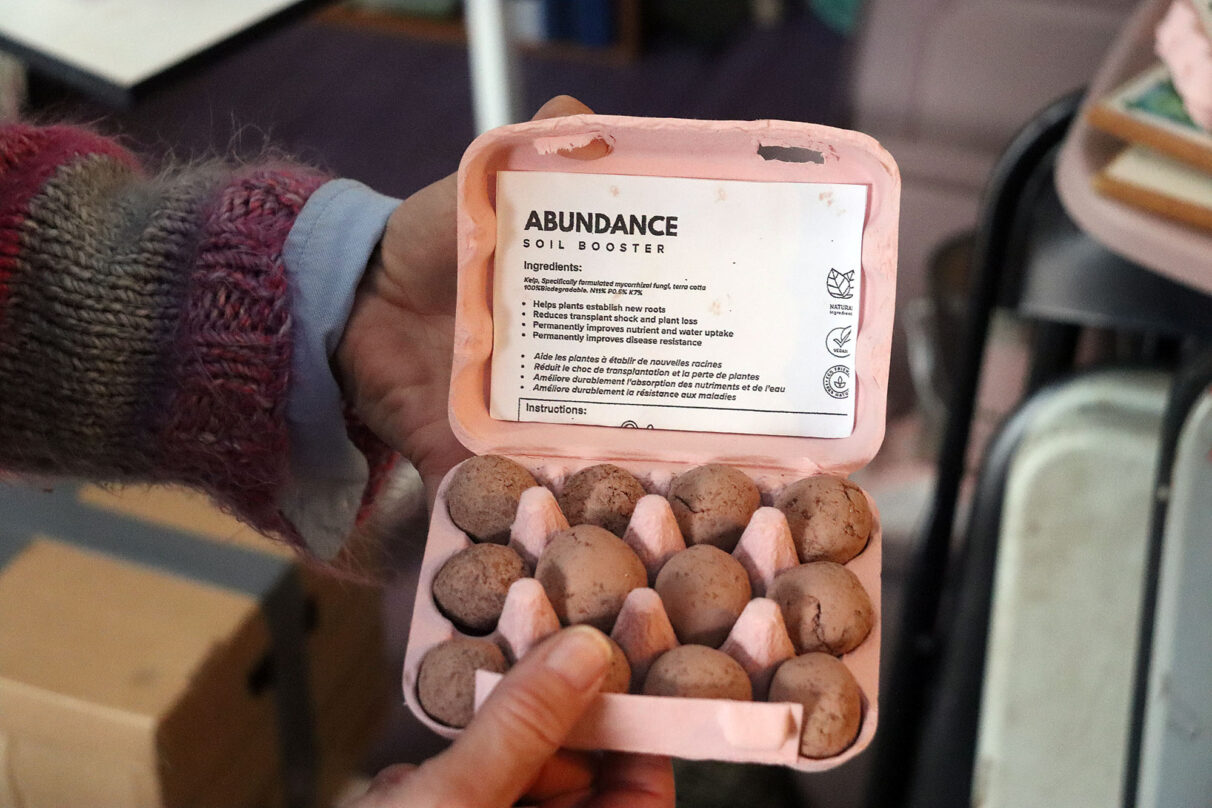
A plant fertilizer called Abundance is shown in Bridgewater on March 20. The product is made out of mycelium and kelp grown in Nova Scotia waters.“I couldn’t find a local, organic source of a fertilizer other than fish meal and bone meal,” said Lohnes in a phone interview with The Signal. “I really didn’t want to use the resources from ‘Big Ag’ or big corporations. So, I went back to my roots and created what we call Abundance.”
Abundance is a kelp and mycelium-based soil enhancer and root binder. The product can be used in gardens, but Helping Nature Heal also uses it to strengthen coastal plant roots to combat coastline erosion.
In 2023, Lohnes trialled the product with 136 kilos of kelp. Since then, the annual amount of kelp she uses in her products has risen to between 300 kilos and 450 kilos.
Abundance is not currently available at retailers due to rules of the Canadian Food Inspection Agency. The company is in what Lohnes called a “CFIA regulation red tape loop.”
“At this stage, we’re still at the kind of market research piece,” said Lohnes. “As far as the CFIA is concerned, we can’t get into local retailers.”
Despite the hurdles, Lohnes feels some regulation is essential and maintains an optimistic outlook on the future of kelp in Nova Scotia.
caption
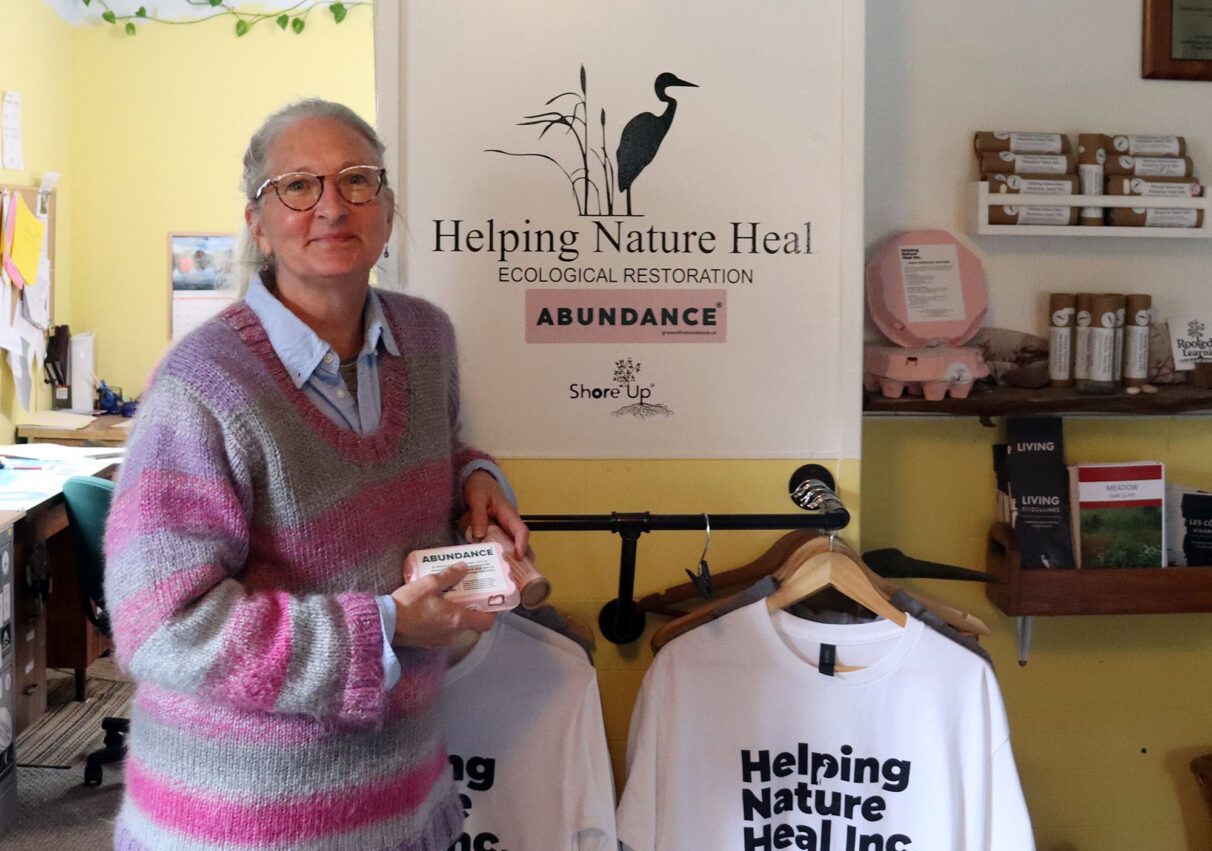
Rosmarie Lohnes poses with Abundance, a plant fertilizer she created. Lohnes uses it in gardens and along the shoreline.“I’m excited to be a part of something new,” said Lohnes. “Finding suppliers, finding a marketplace for it, figuring out CFIA — it’s a huge puzzle with so many little parts.”
Research into furthering kelp harvests is being undertaken at Dalhousie University. Carolyn Buchwald — a chemical oceanographer — uses the university’s Aquatron laboratory facility to optimize kelp growth from seed.
Buchwald co-authored the paper “Optimizing nutrient concentration and sterilization techniques for the sugar kelp (Saccharina latissima) hatchery phase,” which suggests that “proper hatchery protocols can create a good foundation to grow healthy kelp in suitable ocean sites.”
The hope is that research in the controlled Aquatron laboratory can help bolster the early stage of Nova Scotia sugar kelp cultivation, resulting in more abundant harvest yields.
About the author

Olivier Berube-MacInnis
Olivier is in the four year Bachelor of Journalism at the University of King's College. He enjoys writing stories about the environment and sustainability.