Live: Nocturne 2026 a fun, thoughtful night out in the Embodied City
caption
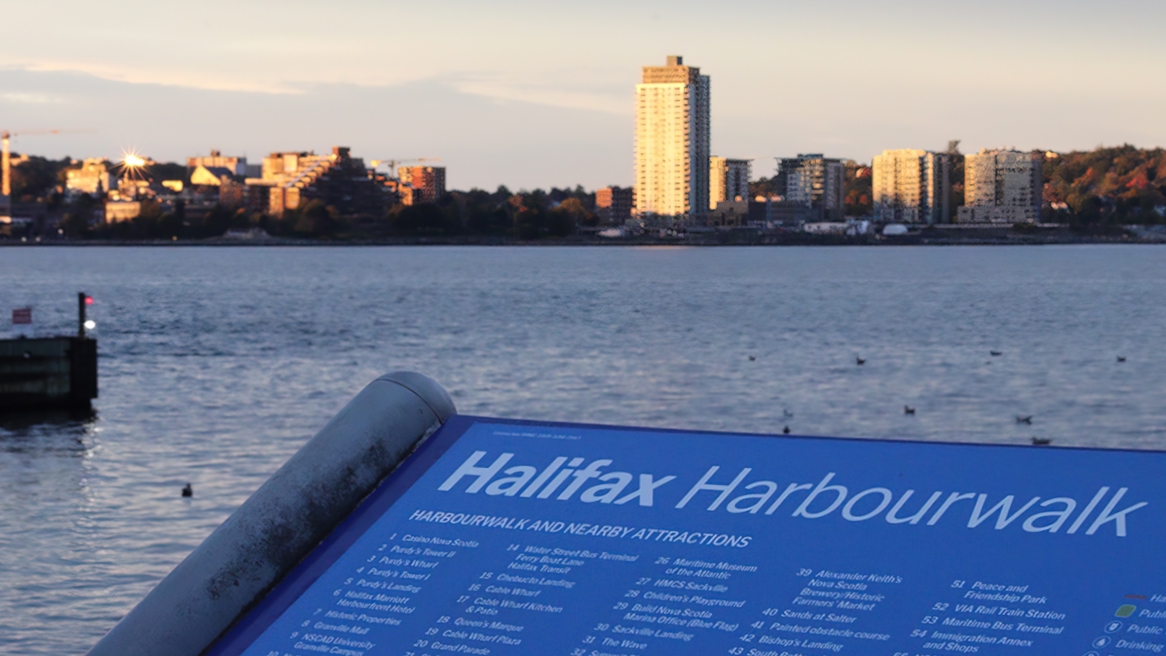
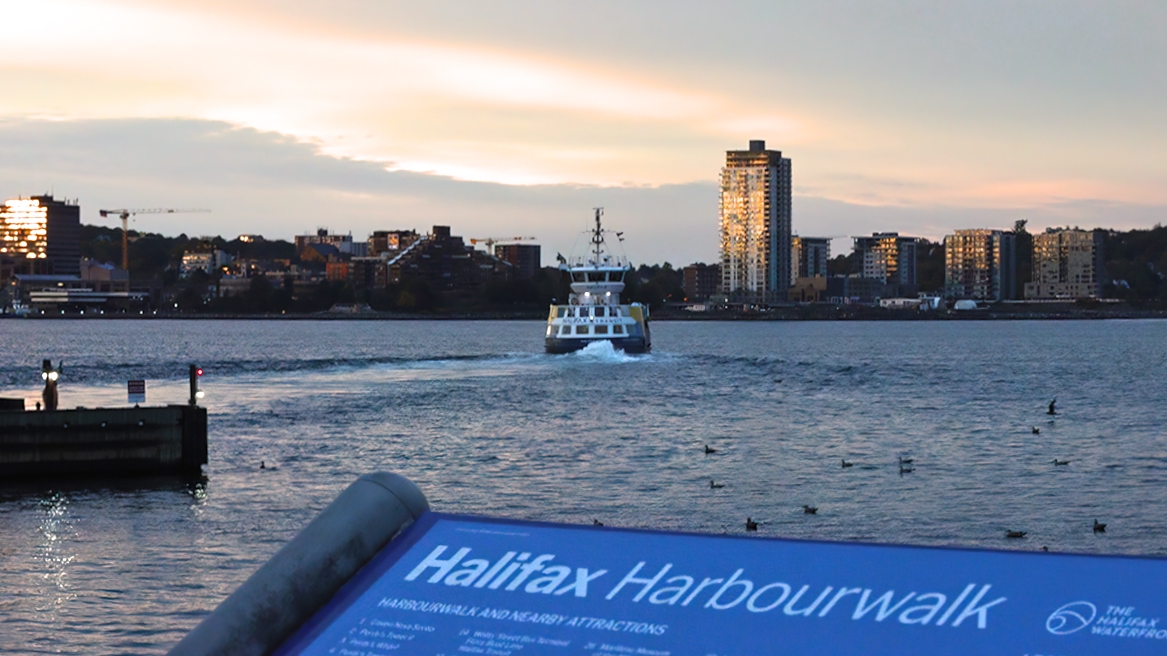
The Halifax Ferry leaves towards Alderney Landing at 6:15 PM on October 17, 2026. During Nocturne, visitors can ride the ferry 15 minutes to view art exhibits both on the Dartmouth Waterfront and the Halifax Waterfront. Photo by Gray Omeasoo- Nocturne’s 19th annual Art-at-Night festival showcased more than 80 projects.
- Featured Project: Celebrate Queer nightlife at Suns in the Nightsky, a video installation shining the excitement of a nightclub across the city streets. Come and join in at Collin’s Court Historic Properties!
- Installations, exhibits and experiences were open 6 p.m. to midnight Saturday, October 17.
12:39 a.m.
That’s a wrap
This live blog was was produced by Viyan Ali, Meaghan Colmet, Emmy Roode, Madison Skip, John Watson and Tal Weisblum. Reporting and photography was done by Katrina Aidelbaum, Alyson Moncur-Beer, Bridget Gault, Molly Nobbs, Madeleine Hurley, Lukas Kohler, Kayla Smith, Allie Zavagno, Qori Aparicio, Miqaela Olatundun, Dylan Follett, Noemi Ryan, Mateo Perusse-Shortte, Gray Omeasoo, Ryan Bradbury, Ian Seckler, Ilyas Pirbhai, Charlotte Wood, Colby Carter, Jacqueline Graif and Damini Awoyiga.
Developing better connections, one call at a time
With the goal of reintroducing uncomfortable situations into comfortable lives, Peter Nightingale and his wife, Laura Nightingale, implement connected phone booths along the Halifax Waterfront.
The project is called Off The Hook, and the goal is for strangers to hear a ringing phone and to pick it up, throwing themselves into a conversation with a stranger.
Laura Nightingale believes that Off The Hook is especially relevant now with the rampant use of cell phones.
“We’ve never been more connected, and yet, we’ve never been more lonely,” she says. “We’re all with our heads down texting and we’re missing out on human connection.
So far, Knightingale has been proven right; those picking up the phone are laughing and exchanging stories about their experiences at Nocturne. She hopes that the event will be a learning experience for the younger generation.
“We just had a couple of kids who picked up the phone and they didn’t know what a busy signal was. Kids these days don’t even know.”
— Ryan Bradbury
Eleanor King’s Take Days fills the night at Halifax Central Library
Crowds funnel in and out of Paul O’Regan Hall at the Halifax Central Library to listen to the Bach Children’s Chorus perform Take Days.
Originally written as a rock piece, this song of “protest,” as described by its creator Eleanor King, carries a powerful message worth listening to. Tackling themes of climate change and corporate greed, the lyrics take on a new dimension through both the voices of its eight young performers and their images displayed on various screens.
“When I was young myself I understood that the climate is changing and we aren’t acting with any kind of urgency, so it felt interesting to work with young people to produce it, to give it some more power,” King said.
To the many that are experiencing Take Days at Nocturne 2026, it becomes evident that music can be more than just entertainment; it can be a call to action.
— Ilyas Pirbhai
Illuminations exhibit lights up the corner of Barrington Street and DaCosta Row
At the intersection of Barrington Street and DaCosta Row, handmade lanterns illuminate the night.
The lanterns are part of an exhibit called Illuminations, facilitated by the arts-based mental wellness program Art and Soul and funded by Spencer House, a senior centre, and the Nova Scotia Mental Health Foundation. The lanterns were all created by a group of seniors.
Lanterns shaped like fish, birds, and a river are situated on the grass and hang from hooks and trees.
Visitors wander among the lanterns and speak to Art and Soul facilitators, who explain to them the process behind the project.
To create the lanterns, Art and Soul held six sessions with participants in which they discussed the question, “what is hidden in our city,” says Art and Soul facilitator Odessa Spore.
“Participants came up with three elements that we saw as recurring themes, which were land, sea and sky. And then images came from that ”
After the three elements emerged, participants formed the lanterns from tissue paper, glue, and chicken wire.
“The final project is beautiful,” says Spore, “but the process was really the best. There was so much joy in our sessions together and in making things.”
— Qori Aparicio
The sounds of community connections
Right across from the Dartmouth Ferry Terminal at the historic landmark, the World Peace Pavilion, artist Rena Anakwe’s project can be heard long before you can see it. “Red Earth/Black Sea” is a sound installation and performance that has deep connections to Anakwe’s community and Africville.
Visitors can be seen closing their eyes and listening to the sounds coming from the speakers.
“I want people to have a sense of reflection and community after listening. All the atrocious things that did happen, I still want there to be joy and pride especially for the folks in the community that I made this for,” says Anakwe
“Also for the general people who are living on this land, I want people to feel a sense of empathy. I think empathy is really important in how we are sitting here together thinking about how the different forms of gentrification, urban renewal or profits over people have impacted all of us. I want people to feel more connected” she adds.
“I have been working on this for months, but the sound itself came together when I came to Halifax. It did not start happening until I got to Kjipuktuk, until I was on the land and everything just formed.”
— Kayla Smith
Ink, Paper, Imagination lets Nocturne-goers get hands-on with printing history
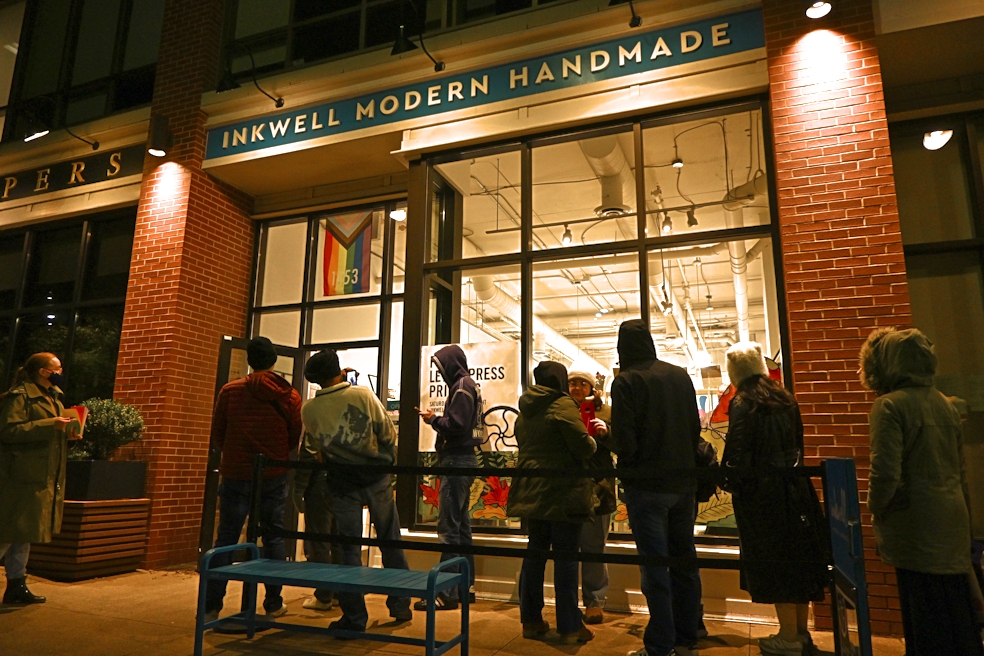
The Nocturne exhibit “Ink, Paper, Imagination” allows attendees to use a piece of printmaking history themselves: a 106 year old antique press.
Hosted at Inkwell Modern Handmade Boutique, the exhibit drew lines out the door to print a “magic viewfinder,” a small piece of paper with an inked design and a hole to look through.
“It’s all about the process,” says Andrea Rahal, who works at Inkwell and helped organize the exhibit.
“It’s a part of history,” she says. “It’s the way written word used to be done, so it’s just a novel thing for people to try their hand at and it’s not often that you get to actually physically use it.”
Inkwell has been participating in Nocturne for 16 years, always putting on exhibits involving the press. The press is on display at Inkwell year-round, and the store sells items made with it.
— Dylan Follett
A patchwork of voices, Nova Scotians contribute to Palestine solidarity quilt
Inside Stitch & Knit, a cozy shop in Downtown Dartmouth, artist‑organizer Kelly Bee welcomed a steady stream of visitors to view The Nova Scotia Grief and Solidarity Quilt for Palestine, a collaborative textile project stitched together by more than 100 contributors from across Mi’kma’ki. The double‑sided quilt, one side crafted by artists and activists, the other by children and families captures both grief and resilience through embroidery, paint, crochet, and traditional Palestinian tatreez.
Bee speaks passionately with guests throughout the evening, explaining how the quilt came together over a year and a half through community “quilt circles.” “I hope people see how many Nova Scotians really do care,” she said. “Community is everything and that’s what’s going to move the dial forward.”
The event also includes a donation station supporting a family in Gaza, adding a tangible layer of solidarity to the night. With its vivid patchwork and heartfelt purpose, Bee’s installation stood out as one of Nocturne’s most emotionally charged stops.
The shop stayed consistently full, with some visitors even mentioning they’d come from Toronto and made a point of stopping in after hearing about the project.
— Matéo Pérusse-Shortte
Bringing puppets to life; an automatonic artist’s work
Inside what used to be Video Difference artist LoHiFi, Chris Little, showcases his automatons. This is Little’s second year in a row using the Video Difference building as his venue.
“I make automatons, which are little mechanical puppets that sort of go through a little cycle on their own,” says Little.
“What’s great about Nocturne is that for an automaton maker there’s not a lot of great automaton venues so for Nocturne it was a great chance for me to bring out all my machines,” says Little.
One of the automatonic’s is a stage with a drummer, once the button in front of the piece is pushed the drummer starts its performance. Another one of the pieces in this exhibit is a large stage-like structure; once the button is pressed a puppet comes down on strings from the ceiling of the stage. This is Little’s personal favourite of the exhibit.
“Halifax is filled with artists but so often we don’t get to see what they do, we don’t get to see them exercise their craft,” says Little, “And Nocturne’s a night where you can go and see them all come out at once.”
— Charlotte Wood
Creating art with inclusion
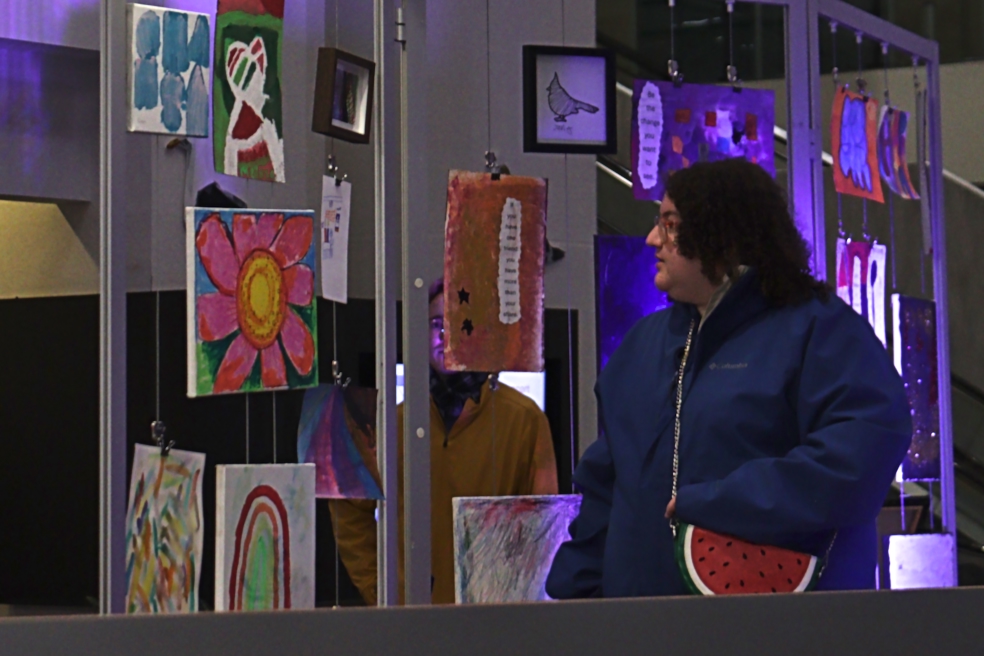
As people enter the Alderney Landing from Portland Street, they are greeted with the vibrant ambience coming from the art exhibition “Layers” created by Dartmouth Adult Services Centre (DASC) artists. DASC is a local community organization that provides employment and creative opportunities for people with intellectual disabilities.
DARC’s Business Manager, Abbey Girard, says she hopes the organization’s project, Layers, encourages audiences to look past a diagnosis. Layers provides an inside look into what makes us happy as humans, what makes us scared, our strengths, our weaknesses and how we celebrate that.
Girard shares that Layers is a celebration of DASC’s 60th anniversary leading up to their show which is being held on Oct. 22 from 6 p.m. to 8 p.m. at their main location, 59 Dorey Ave. in Dartmouth. The show is a fundraiser and tickets are on sale on DASC’s website and on their social media. Girard invites visitors to come check it out.
— Kayla Smith
Income inequality: not a black and white Issue
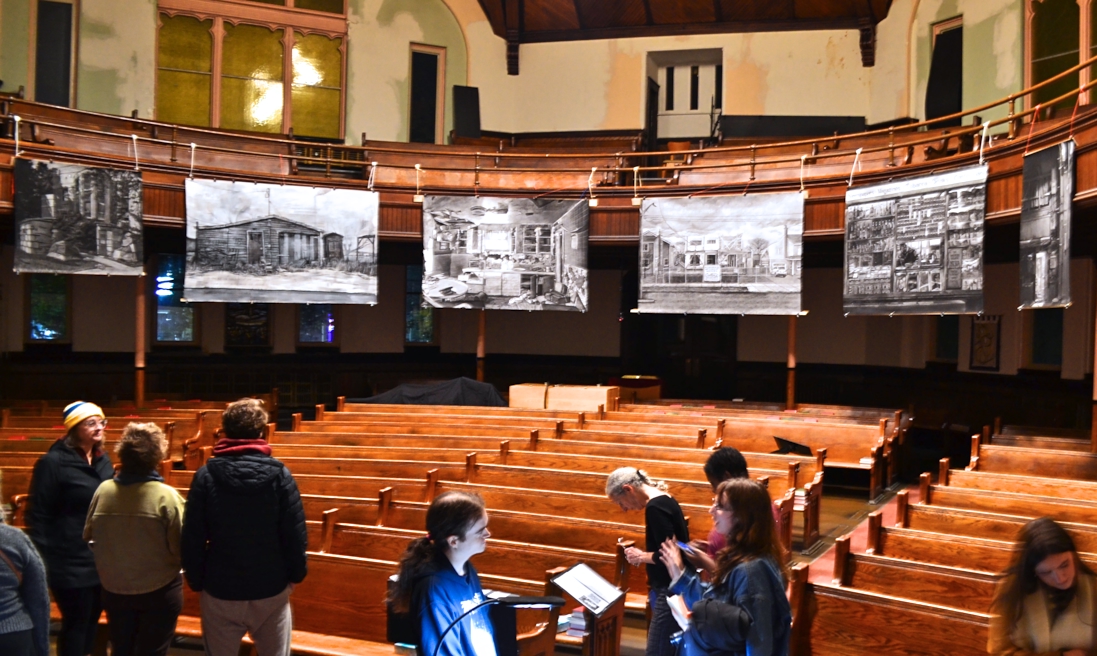
At the All Nations Church, the balconies and pews are lined with meticulously detailed charcoal drawings by Halifax-based visual artist Curtis Botham.
Botham’s work examines income inequality in Nova Scotia and how the for-profit housing industry affects people being priced out of their communities. The eight-foot-wide drawings depict various types of dwellings, including homeless encampments, abandoned houses and new construction, highlighting the realities faced by people in the city.
“This year’s Nocturne is particularly important, because it comes at a time when the Nova Scotian government has shown themselves to be in complete contempt of arts and culture, and is willing to throw artists, librarians, museum workers, and other sort of cultural institutions under the bus to fix their own mistakes,” says Botham.
“So, for something like Nocturne to be happening, that brings people together from all walks of life, with their different projects, their different disciplines, to show that cities can still be places of communities and not just places where you’re priced out of everything, I think it’s really important to have reminders like that.”
— Katrina Aidelbaum
Think you know Halifax? This exhibit puts it to the test
Inside The Trainyard, a small gift shop in Downtown Dartmouth, organizer Erin Ferguson invites visitors to test how much of their daily commute they truly notice.
A display board at the back of the shop features close‑up photos of murals, signs, and architectural details from around Dartmouth and Halifax, printed to resemble Polaroids. Guests are encouraged to guess each location before flipping the image to reveal the answer. Most visitors filter in from other Nocturne stops nearby, giving the space a steady but relaxed flow as people pause to try the challenge.
Ferguson says the project came together through simple observation. “I walked around downtown Dartmouth and Halifax keeping an eye out for structures and murals people might find familiar,” she explained. Early feedback has been playful, with many guests surprised by how often they misidentified familiar landmarks. Ferguson noted that younger visitors were especially quick to recognize the images, adding, “I’m wondering if it’s because they’re less distracted, maybe they’re not the ones focused on traffic or on their devices.”
— Matéo Pérusse-Shortte
Bringing together film and multichannel sound
In a quiet room tucked away on the fourth floor of the Dalhousie Arts Centre is Nocturne’s Sonic Visions.
Produced by Dalhousie’s composition students with the Fountain School of Performing Arts, it features 2 projects of electroacoustic compositions played to video visualizations.
The first one, Bad Piggies by Jamie Bryden, features an upbeat track to video compilations of police body cam footage, police raids, gun manufacturing, and various political speeches regarding police commissioning.
The second composition, Prismatic Reflections by Jess Cheverie, took a different turn and had calming music playing to videos of aquatic life in the many aquariums around the Dalhousie campus, and other slow paced footage.
“It was really peaceful”, says audience member Joanne Phillips, “peaceful, collaborative, and natura.l”
Open to all, it is intended for the audience to come and go as they please, and the two compositions will be shown until midnight.
— Noemi Ryan
8:28 p.m.
Cradling peace
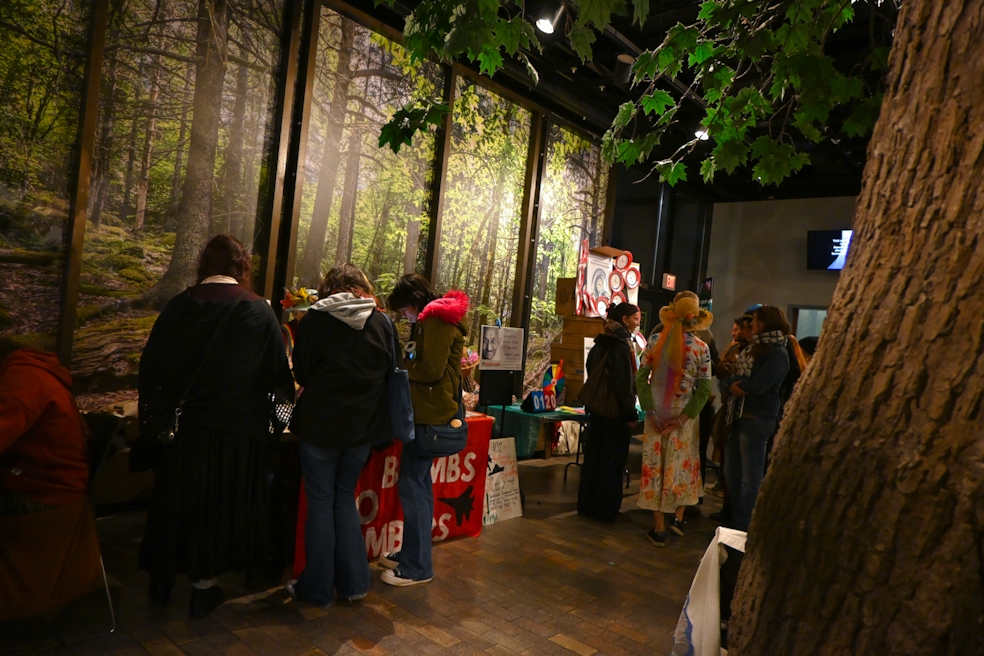
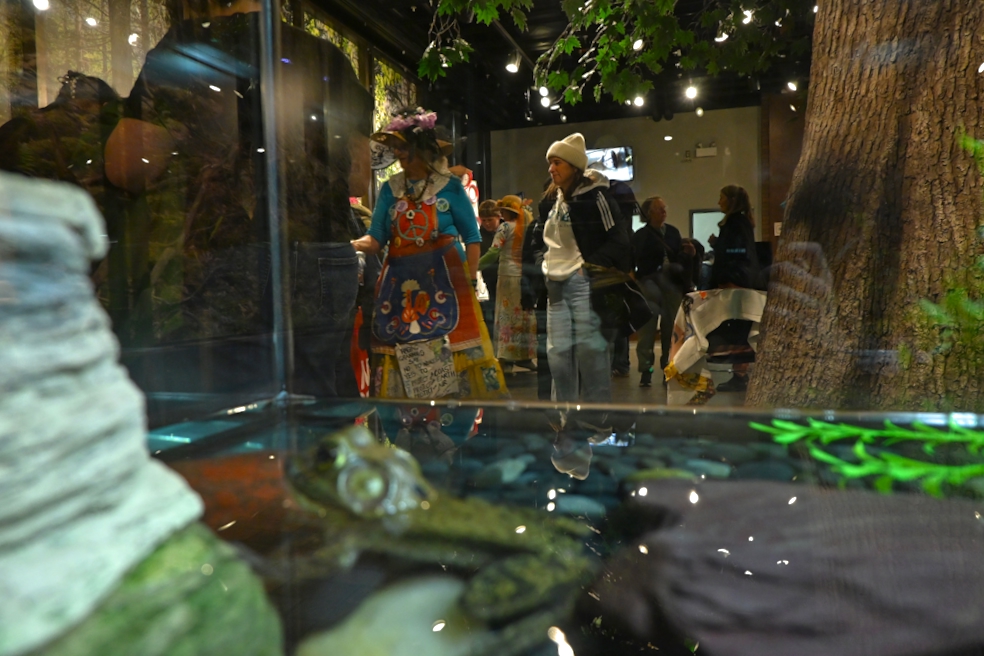
The Museum of Natural History housed Halifax’s Raging Grannies this evening for their interactive exhibit, Cradling Peace.
From their colourful hats and outfits, to their renditions on songs like “If I Had $1,000,000” by Barenaked Ladies, these Grannies are serious about the doomsday phenomenon. They hope for us to imagine a world filled with peace and care for their community and the planet.
One of the newest Raging Grannies, Marianne speaks about the story of Sadako and the thousand paper cranes. Sadako, a young girl from Hiroshima, survived the atomic bombing, but later developed leukemia. According to Japanese legend, a person who folds a thousand paper cranes will be granted a wish. Since then, paper cranes have become an international symbol of peace. “I think everyone should experience peace and anytime is a good time for peace,” says Marianne.
With interactive games, petitions and even the opportunity to make a handmade pin, visiting these Grannies and their exhibit is a treat.
– Bridget Gault
8:19 p.m.
8:03 p.m.
Enamel painting and a NSCAD jewelry exhibition by the waterfront
At the bustling Yu Yo Craft Supplies + Tea House, NSCAD is hosting its Jewelry and Metalsmithing department exhibition while visitors partake in an enamel painting workshop.
Yu Yo is a cozy craft supply and tea shop on the waterfront. This evening, it’s hard to move around the small but lively space. Visitors sit at tables painting small enamel lobster claws, while Qu’s daughter monitors their work.
The collaboration between Yu Yo owner Mengnan Qu and the Jewelry and Metalsmithing department has been an annual tradition since 2016. “Last year, we got 120 pieces,” says Qu.
After painting the enamel, visitors can either buy their pieces or leave them as part of a community mosaic. Proceeds from this year’s workshop will fund materials for next year’s workshop.
Visitors to the NSCAD exhibition can vote for their favourite piece. The winner will receive a $200 gift card to Yu Yo.
– Qori Aparicio
7:53 p.m.
Reimaging plastics through puppetry
Sheila Christie, the curator of Plastic Futures, invites participants to view plastic as a resource rather than as trash. The artist is repurposing everyday plastics, such as laundry jugs, yogurt containers, and curtain rods. The project aims to encourage participants to re-purpose waste in a way that’s not only productive but creative.
Inspired by her daughter’s drawings, Christie took the inspiration to make the drawings three-dimensional.
“It started by figuring out what we could do with plastics and gradually, over time, we built some giant puppets,” says Christie.
By taking household items and repurposing them, Christie has hopes that the exhibit will inspire participants creatively.
“I want people to feel like they have more agency and that they can use their creativity to solve the problems around them rather than hoping that someone is going to provide a solution for them,” Christie says. “Let’s see what we can do with what’s already in our house.”
– Madeleine Hurley
6:46 p.m.
Visible cities and constant creation
How Ada Denil’s waterfront exhibit emphasizes unseen experiences.
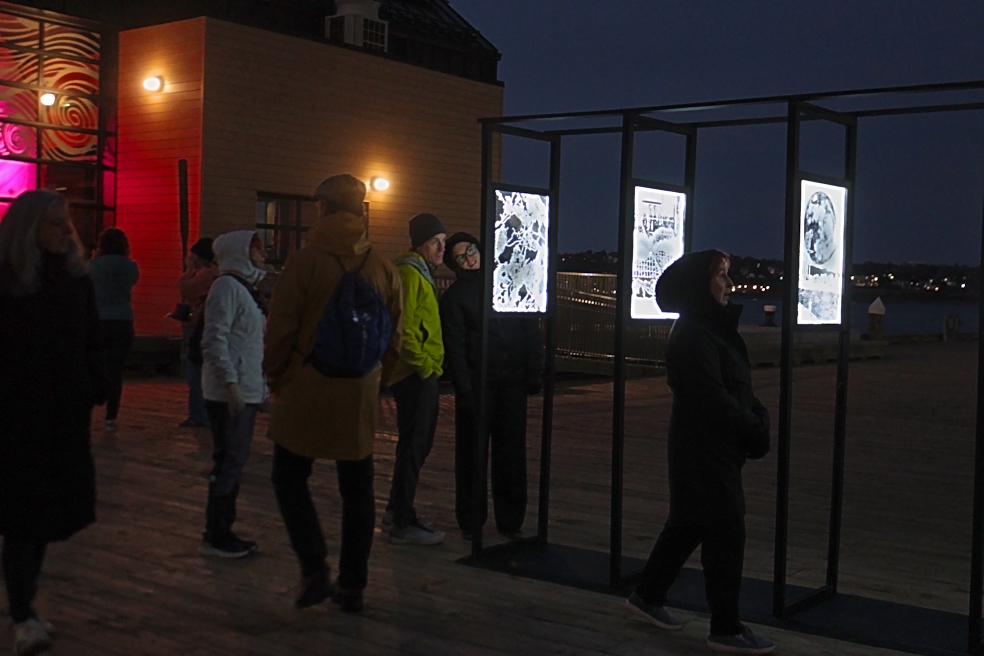
Inspired by Italo Calvino’s novel Invisible Cities, the five acrylic panels depicting imagery such as city buildings and streets are arranged to encourage viewers to consider not only how they move through Halifax, but also how they move through any physical space.
“As someone who lives in Halifax, I was inspired to make that the focus,” Denil says. “But it could really be about any place in a lot of ways. It’s not really glued to its geographic location.”
Through layers of imagery and creating the spaces we exist in, Denil hopes the exhibit will help people observe the spaces around them.
“Hopefully people can think about how through our actions and reactions to places and people around us, we’re constantly creating these spaces,” Denil says. “You end up at this hopeful place where you realize that we’re actually creating the spaces we move through.”
– Madeleine Hurley
6:10 p.m.
Nocturne: A platform for the arts and reconciliation
Nocturne has been an essential part of the local arts community for almost 20 years. Based in the Kjipuktuk/Halifax Harbour, this non-profit organization has made its mission to highlight community, connection, and empowerment through different art forms and themes. This year’s theme is Embodied City — an exploration of the somatic knowledge and experiences of the body, and the many ways people can connect with their everyday environments.
For Nocturne, the embodied experiences of humanity are also about acknowledging the ancestral and unceded territory of the Mi’kma’ki people. Over the years, Nocturne has put an emphasis on reconciliation in the arts, prioritizing Indigenous artistry, partnerships, as well as BIPOC creators and community.
When asked why reconciliation in the arts is so important, Melany Nuget-Noble — Executive Director of Nocturne, shared a quote by American painter Robert Rauschenberg, something she believes perfectly resonates with this call to action:
“Artists have always been the first to respond, whether it be earthquakes, starving children, sinking venice, (or) political atrocities…Art has always been a necessary ally to justice and freedom.”
– Miqaela Olatundun
6:05 p.m.
The Pop Can serves as Nocturne HQ
Located on Halifax’s vibrant waterfront, a shipping container known as the Pop Can has been transformed into Nocturne’s central hub, welcoming visitors since Wednesday in the lead-up to the festival’s main night.
Presented by Build Nova Scotia, the hub offers festival guides, stickers, and insider information for anyone curious about the weekend’s installations. The guides map out exhibits across the city and share details about this year’s theme and schedule.
Echoing the theme, Ground, the hub feels like a starting point – a place to pause, get your bearings, and step into the city’s network of art installations.
The Pop Can draws both locals and tourists. On Friday afternoon, a dozen volunteers and organizers were on hand – some at the hub, others walking the waterfront to chat with visitors. Artists also stopped by to socialize ahead of their installations.
“The hub is meant to be a place where the volunteers can come as well as the public to know more about the festival,” one volunteer explained. Compact but lively, the Pop Can captures Nocturne’s spirit – art everywhere, for everyone.
– Allie Zavagno
6:01 p.m.
What to know before you go
Nocturne volunteers say there is no wrong way to explore the exhibits, but being prepared will make all the difference for an incredible night.
If you’re packing a bag, make sure to include your phone, a portable charger, snacks, water, and an extra light. For tonight’s colder October weather, don’t forget tissues, gloves, a scarf, and warm shoes.
Here’s Volunteer Coordinator Julia Millon’s top tip for people who want to maximize how many exhibits they can visit:
“If people use the online map, you can star different places you want to go. Then, you can look at your digital map and make sure that you have gone to the ones you have starred.”
– Alyson Moncur-Beer
6:00 p.m
The Signal is reporting live from Nocturne 2026
Tonight, The Signal’s reporters and photographers are spread out all over the city to capture the sights, sounds and feelings of Nocturne.
Our team in the field and here in the newsroom will bring you updates, exclusive interviews and the most extensive coverage available as the nighttime art festival unfolds.