
The price of a first byline

Internships remain a key pathway into Canadian journalism, but financial pressure on students and newsrooms is raising questions about who can afford the experience and who should pay for it
For six weeks, Olivia Belovich worked at CBC without a paycheque.
The master of journalism student had a placement on About That with Andrew Chang in Toronto. It was the kind of thing that could stand out on a young journalist’s resume, and an opportunity to see how a national newsroom worked from the inside.
But taking it required more than simply saying ‘yes’.
Belovich normally lived in Ottawa and attended Carleton University, where she worked part-time at a bakery to help cover her living expenses. In order to spend six weeks working unpaid in Toronto, she had to find somewhere else to stay.
Her family lived in Oakville, a 40-minute drive from downtown, so she moved home temporarily, avoiding rent while her parents helped with food and her dad drove her to work.
Carleton provided $500 in financial assistance.
Without all of that, she said, the internship could not have happened.
“I would not have been able to do the CBC internship if I didn’t have family within, like, a train ride away from downtown Toronto,” Belovich told The Signal. “If they had offered me something for the whole summer unpaid, I would not have been able to take it.”
During her CBC placement, much of her work on About That involved associate producing — editing scripts, researching and booking guests — rather than reporting.
A few weeks later, Belovich started another internship, this time at the Ottawa Citizen.
Then the paycheques started arriving.
“Oh my God,” she remembered. “Those first paychecks were, like, incredible.”
From classroom to copy desk
For journalism students trying to make the leap from school into a profession that prizes experience, Belovich’s two internships illustrate a tension built into one of the industry’s most established entry points.
Internships can offer the things that are difficult to reproduce in a classroom — professional bylines, newsroom contacts, mentorship and the experience of reporting on deadline — but can also require students to take on the costs that come with unpaid work.
At the same time, declining revenues and shrinking teams have left some newsrooms with less money to pay interns and fewer journalists available to train them.
Some newsrooms continue to offer unpaid academic placements, while others have found money for paid internships or rely on public funding to create early-career positions. That has created markedly different pathways into Canadian journalism.
But if internships are important to getting into journalism, who can afford to take them —and who should pay?
For Belovich, the difference between learning journalism at school and practising it in a newsroom became particularly clear at the Citizen.
“The skills at The Citizen are skills that you kind of have to learn on the job. . . . How to interview people, the way municipal politics works.”
caption
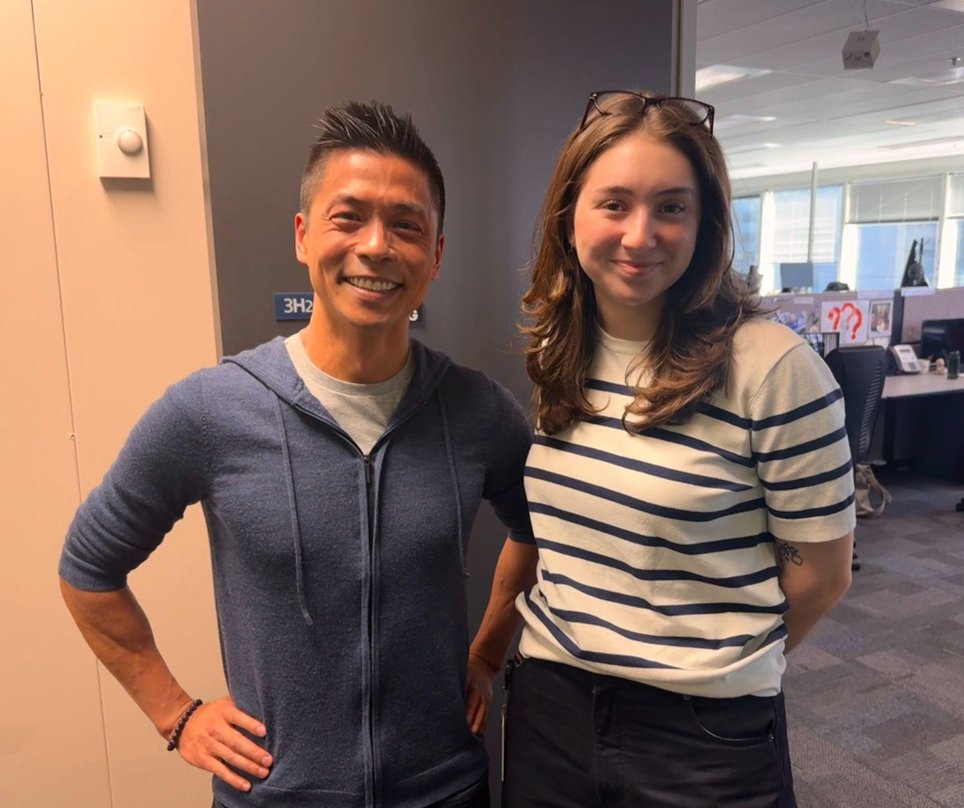
Olivia Belovich poses for a photo beside Andrew Chang, from CBC’s About That. Belovich worked at CBC as an associate producer during her first journalism internship, from March to May 2026.The Citizen reporters met virtually at 9 a.m. each day to talk through the day’s stories. Robert Hiltz, the news editor, gave out some assignments, but most reporters were expected to pitch their own ideas.
For Belovich, this meant a variety of stories covering everything from crime, to Ottawa’s Bluesfest, supervised consumption sites, and to her personal favourite, the closure of a beloved Chinese takeout restaurant.
“There was so much trust from the editors,” she said.
At the Citizen, there were stories that needed to be written and not always enough people to write them, which meant the interns were given real assignments.
“I’ve learned way more in those four months than I did in the entire year at Carleton,” she said.
“It’s not the school’s fault, that’s just the nature of the newsroom, where you just get there, and you go, and you file it, and the editors tell you it’s terrible, but then slowly you realize why it’s terrible, and then you never make the same mistakes again.”
At Concordia University, internship co-ordinator Lucie Laumonier has watched students use placements to accumulate professional bylines, develop practical skills and, in some cases, turn an internship into a job. She described the experience not as an optional embellishment to journalism education, but as part of the transition out of it.
“I absolutely think that internships are a pathway between the classroom and the newsroom,” Laumonier told The Signal.
The problem is that the bridge has become harder to maintain from both ends.
One of Concordia’s major internship partners, Global News, stopped taking students after mass layoffs reduced the newsroom’s ability to supervise them. Interns contribute to a newsroom, Laumonier said, but they also require staff time for editing and mentorship.
The cost of doing news
For students, the obstacle is often more obvious.
“The issue I see is that most internships do not pay their interns, and so getting an internship is a privilege,” Laumonier said.
A student working an unpaid placement still needs groceries, tuition or rent. Laumonier said being paid can allow interns to reduce hours at a part-time job they may rely on to pay bills, and devote more attention to their journalism.
A 2026 TD survey found that 89 per cent of post-secondary students surveyed had experienced financial stress in the previous three months, with groceries and housing among the leading causes.
But students aren’t the only ones facing financial struggle.
Canadian newspaper publishers brought in $1.6 billion in operating revenue in 2024, according to Statistics Canada, a 17.9 per cent decline from 2022. Over the same period, spending on salaries, wages, commissions and benefits fell 17.6 per cent.
So students have less financial flexibility to accept unpaid work, while newsrooms have fewer resources to invest in the people trying to enter them.
A 2023 Canadian study of journalism internships captures the collision between those pressures. Sixty-five per cent of student respondents said they would be less likely to apply for an unpaid position, and considered being paid extremely important or very important. While 59 per cent of newsroom employers agreed in principle that interns should be paid, they pointed to limited budgets, union rules and staff shortages as barriers.
Who pays for the way in?
These competing pressures help explain why two of Canada’s largest media organizations have arrived at different internship models.
CBC Toronto’s academic internship program brings in roughly 45 to 50 students each year for six-week placements across its programs.
“Our goal is really to have students learn as they’re working,” Tina Verma, staffing lead for CBC, told The Signal.
The placements are unpaid. Verma said paying interns would likely result in financial strain for the newsroom, and mean accommodating fewer students. CBC’s union arrangements further complicate the distinction between academic interns and paid workers.
For CBC, this trade-off allows more students through the door. Verma estimates about 35 per cent of interns become casual CBC employees immediately after their placements.
At Postmedia, publishers of the Ottawa Citizen, executives looked at many of the same financial constraints and made a different decision.
Summer student programs had largely disappeared from its newsroom by 2020, something Joe Ruscitti, Postmedia’s vice-president of news, attributes bluntly to economics. Eventually, however, the company decided that what it was losing was worth finding money for.
“Good journalists are hard to come by these days,” Ruscitti told The Signal. “It’s an area for us to discover the sort of next generation of talent and to help foster that generation of talent and, frankly, get them into our newsrooms.”
In June 2026, Postmedia launched a nationwide summer internship program, bringing over a dozen student journalists and recent graduates into newsrooms across the country.
The decision to make the positions paid was crucial.
Ruscitti, who completed an unpaid internship himself, said he was never comfortable with the idea of asking students to provide free labour just because the experience benefits them.
“We found the money. We took it from elsewhere,” Ruscitti said. “We duct taped and band-aided and found ways to get enough money to do it because it’s important.”
“I think we have some responsibility to help care for the next generation of journalists and . . . help them in their little journey up the journalism ladder.”
Finding another byline
Smaller organizations have found other ways to pay people entering the industry.
At Halifax’s online news outlet Grand Parade, publisher Matt Stickland budgets to pay a writer every week. When that writer is an intern, he doesn’t see why their student status should suddenly make the work free.
“It doesn’t really make sense for me not to pay a writer for four weeks of the year, just because they’re a university student,” Stickland told The Signal.
He gives himself more time to edit a student’s story and gives the intern more leeway to make mistakes, but the expectation remains that they are participating in professional journalism.
“It is a real work environment. You’re doing a real job,” he said. “You’re getting paid the real wage for that job.”
Jenna McConnell completed her required 120-hour journalism internship at the Grand Parade. After graduating from the University of King’s College, she moved to CKDU, where she now works in a paid 10-month internship position funded through the federal government.
The job has allowed McConnell to develop skills in audio reporting and radio writing while working independently.
caption
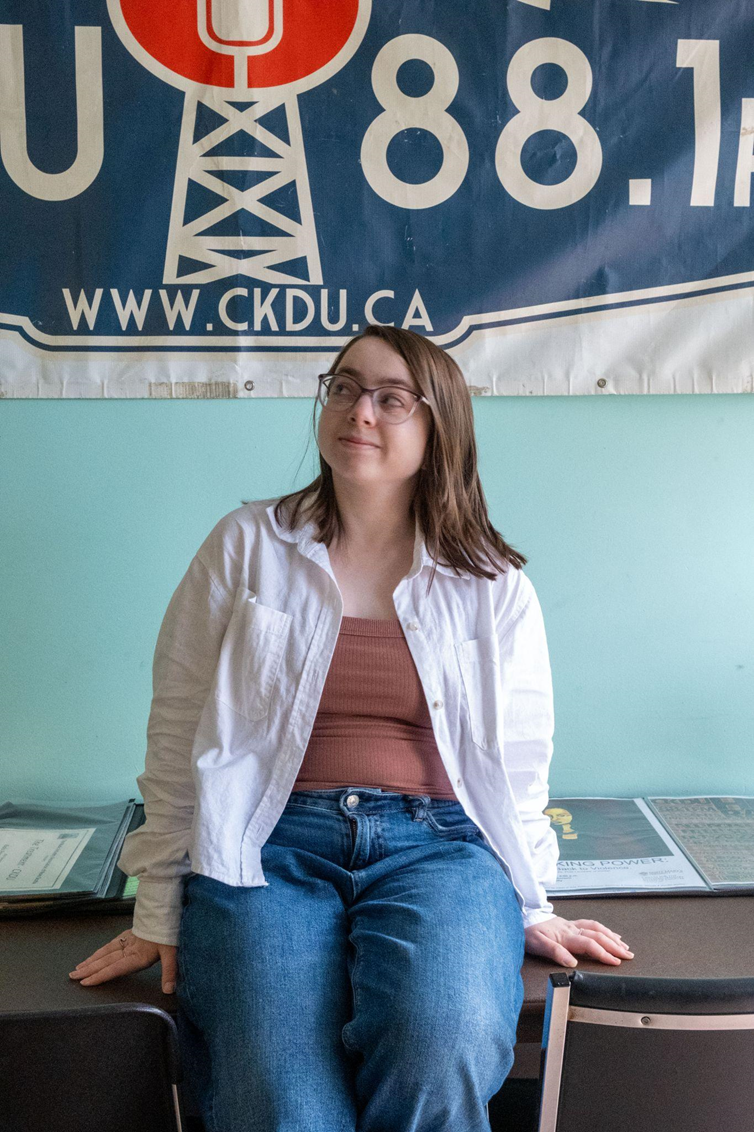
Jenna McConnell poses for a photo under the CKDU radio banner. McConnell works in a paid 10-month internship position funded through the federal Local Journalism Initiative.Finding the money
But for a small campus-community station like CKDU, creating a paid position depends on finding money for it.
Megan McCracken, CKDU’s operations director, said government funding is particularly important for community and campus stations, which generally work with tight budgets.
McConnell’s position is funded through the Community Radio Fund of Canada (CRFC), which distributes a portion of the federal Local Journalism Initiative to community, campus and Indigenous stations.
CRFC executive director Alex Freedman sees funding early-career journalism as particularly important in an industry where entry-level opportunities are increasingly difficult to find.
“Making sure that there are spaces in media that pay a living wage for journalists fresh out of school, so that they can get that portfolio that they so desperately need is, I would say, critical to the future of journalism in Canada,” he told The Signal.
“Community, campus, Indigenous radio is a place where you can get that first spin, where you can get that first time behind the board, where your voice can be heard for the first time.”
The next assignment
For students, the outcomes of internships can last well beyond the placement.
Laumonier has watched students turn internships into professional experience, and future careers.
“I really think that these internships are stepping stones for students,” Laumonier said. “It’s kind of the magical key to get a job.”
For Belovich, the next steps are still ahead of her, as she returns to Carleton to finish her master of journalism degree. But when she begins applying for jobs again, she hopes the two internships will help her résumé stand out.
“I think it’s a really nice way for me in a year to say, look at my resume when I’m applying to wherever. I already know how to operate in a newsroom.”
About the author

Lynnette Alford
Lynnette Alford is a second year journalism student from British Columbia.
Leave a Reply