
Q&A
Why freedom has more meaning in Ukraine
A conversation with Kyiv Independent editorin-chief Olga Rudenko
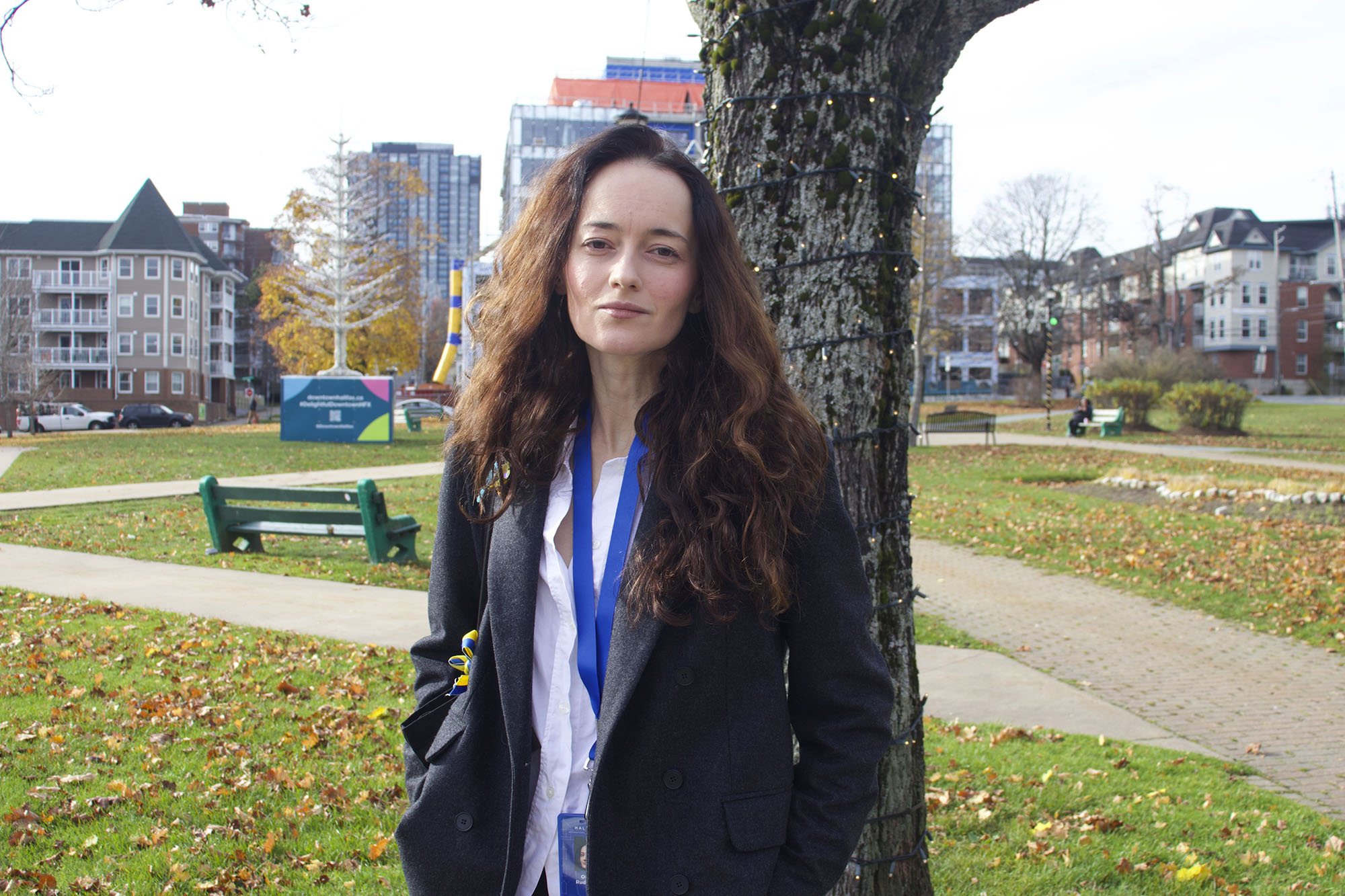
caption
Olga Rudenko, editor-in-chief of Kyiv Independent, was in town last weekend for the Hailfax International Security Forum.Last weekend, downtown Halifax played host to the annual Halifax International Security Forum. The forum brought roughly 300 people from 70 democratic nations to the city, and hosted speeches, panels and discussions from military experts, political leaders, defence officials and policy analysts.
Among this year’s crowd was Olga Rudenko, editor-in-chief of the Kyiv Independent, an English-language media outlet in Ukraine that was created three months before the full-scale invasion by Russia.
The Signal sat down with Rudenko, 37, who was in town to present on a panel about Russia’s war on Ukraine, at the Westin on Nov. 20. In advance of the panel, Rudenko wrote an essay, Attacked Incumbents, Alternatives Incoming, in which she discussed the erosion of democracy in Ukraine, and its citizens fight to maintain their freedoms within their country while fighting Russian invasion.
The conversation, which has been edited for length and clarity, delves into the fight for democracy in Ukraine and the need for journalists to continue speaking truth to power.
The forum has a strong focus on AI. Do you have any concerns as it relates to your job?
Rudenko: No, surprisingly.
You would think that AI would be a bigger threat to factual journalism, specifically on the ground in Ukraine, because we usually can’t be on location to verify something with our own eyes. So, we have to rely heavily on ground testaments from people. And even without the threat of AI, it’s really very difficult because you can’t verify those things.
We are always very transparent about it. We always say this can’t be independently verified. I’m honestly personally a little surprised, as I would think AI would be used more to spread fake narratives and to falsify some battlefield reports, for example. But the way we see it used for disinformation related to the war is, very surprisingly, unsophisticated. We’ve been covering it quite a lot.
We’ve been producing something called Disinfo Check, which is a series of stories looking at fake narrative. There were fake AI videos that supposedly portrayed Ukrainian soldiers talking about especially harsh conditions within the war. There were images and videos of Ukrainian soldiers in the trenches talking about some hardships.
But they’re the kind of videos where you look at them and . . . immediately know that it’s AI. I suppose there might be some people who are less exposed to that, who may not have enough of a media literacy to understand. Not to be thinking for the devil, but I think there are ways to use AI in a more sophisticated, more harmful way to fake something. But so far, the way we’ve seen it being used . . . it’s a threat that has not yet fully materialized.
Are we fighting to stay in the club that others are trying to leave?
Olga Rudenko
I read your essay for the plenary session. What does unfreedom mean to you?
Rudenko: Unfreedom . . . it’s not just the absence of freedom. It’s more like the rejection of freedom, the giving up of freedom. It’s one of my least pleasant realizations of the past few years, that people are not always by default attracted to freedom. Sometimes people reject it or give it away in exchange for something that they think is reasonable, like some security or just the comfort of mind to release oneself from the need to (make decisions).
I think people sometimes reject freedom as a way for a simpler life. And that’s what we see in some places in the world now, where parties coming to power and in their promises they have very heavy hints that choosing them would lead to a decrease in freedoms and liberties, but you will still increasingly support them and vote for them. It’s troubling, seeing that as a Ukrainian, because this is what Ukrainians are fighting for, to stay (a) democracy and to stay free. To watch it from Ukraine can be especially surreal because, as I wrote, sometimes it feels like, are we fighting to stay in the club that others are trying to leave?
You say that you’re “having to watch people in peaceful nations give their (freedom) away without a fight, trading it for the unreliable promise of fewer migrants and cheaper groceries.” What do you want Canadians to take away from this messaging?
Rudenko: I know, obviously, what the U.S. president has been saying about Canada, which is insane. He said Canada doesn’t make sense.
I think everybody (saw) what Putin and Russia communicated about Ukraine, about wanting to reverse the fallout of the Soviet Union . . . It was just words, a politician saying something. And then when he tried to end Ukraine in 2022, everybody was suddenly like, ‘Oh, he actually meant it.’ It was out there. He was saying things that he was actually meaning.
That kind of colours the way I look at statements like the ones Donald Trump makes about Canada or Greenland. I think I read that Canada is preparing, for a possibility of a military invasion from the US. That doesn’t sound crazy to me at all, coming from where I come from. Especially when somebody in power says a sovereign country doesn’t make sense, that really rings a bell where I’m uncomfortable.
I hope that nobody will be able to abuse this (strained) relationship to rise to power on a strongman agenda.
What role do you think journalists play in upholding democracy during wartime?
Rudenko: It’s a crucial role in any democracy. It’s one of the checks and balances (in) the system. If journalism is done right, if it’s fair, fact-based, well-sourced, if it serves as watchdog journalism, it’s doing a huge public service. And in our country, because democracy is effectively on pause in a way, the democratic process is on pause because we can’t hold elections during martial law. Free media remains one of the ways in which the control of the government can be exercised, in which (the) public can sort of control the government because there’s no elections.
Another way still available to Ukrainians is protesting, which Ukrainians have done a couple of times over the past couple of years. And yes, having free media that can keep power to account and serve as watchdogs, especially during the war, is very important. It also becomes, inevitably, sort of a barometer of the state of democracy. Is there independent media in the country? How free are they in what they’re writing about? Is there retaliation after certain stories? So, this inevitably becomes a metric for a healthy democracy.
You also spoke in your essay about protests in Ukraine, against perhaps some of the more extreme wartime measures. How important is protesting to democracy?
Rudenko: I think very. Coming from Ukraine, you can’t overexaggerate it. The fate of my country has been decided by a few specific very large protests. We had a very important student protest in the 90s, and we had a protest known as the Orange Revolution in 2004, which changed the course of elections because people protested against elections being rigged, and led to a re-done election and a pro-Western candidate won instead of the pro-Moscow one.
So that decided the fate of the country for the next several years. Then, when a pro-Moscow candidate won the next election (in 2010), it led to a whole revolution in 2014 that unfortunately was bloody and over 100 people were killed. It overthrew the pro-Russian president, and it set the country firmly on the pro-Western course. That’s what we know as the Euromaidan Revolution. It became a watchdog moment for the history of my country. And a lot of institutions that are very important for Ukrainian democracy now, including anti-corruption institutions, were set up after that revolution. I was in my early 20s at the time, and as a reporter I was covering that while also participating in the protest.
The spirit of that revolution (was) an impulse for the country, and for institutions and democracy that has been found in the years that followed, and when the next large protest happened (in July 2025) . . . that was a huge deal. It was very surprising to see it. It was surprising in a way, but I personally didn’t know whether, after living for a few years under the full-scale invasion of martial law, people would still have it in us. You need to have the kind of faith that it will help, the faith that you can make a change, you can demand it. You need to have, as a citizen, a certain kind of understanding or belief that your voice deserves to be heard, so that you can make a difference. You need to be in a place that is the opposite of disbelief and disappointment and disenchantment. You have to be optimistic in a way to protest, right?
The best part of it was that those were very young people. Those are the people who mostly didn’t participate in the revolution in 2014. This was probably their first one. They were in their very early 20s, most of the crowd that came and had never voted. They never experienced democracy. This was their first probably true experience, that is a very classical democratic experience to protest for and achieve some change.
Is there anything else you would like to add about the forum, the war, or the role of journalists in your position?
Rudenko: Canada has been such an important and true partner and ally for Ukraine, in these circumstances. I’m really excited about this forum bringing me for the first time to this country. Obviously, there’s a lot of connections, a lot of people Ukrainian ancestry who live in Canada, and so I’m just super happy to be here.
About the author
Kendall Nestor
Kendall is a King's Bachelor of Journalism student. She is passionate about politics and pop culture.
Leave a Reply