
FOI legislation should include power to issue orders: former information commissioner
Tricia Ralph says revamped act allows province to ignore rulings on freedom of information

caption
Province House in Halifax, where the Tim Houston government passed a revamped freedom of information bill in 2025.Nova Scotia’s revamped Freedom of Information legislation should have given power to issue orders to the province’s information commissioner, says a former holder of that post.
Tricia Ralph, who was Nova Scotia’s information commissioner from 2020-25, does not take issue with legislation surrounding the ability to disregard trivial, frivolous and vexatious requests so long as there is commissioner oversight and it is used rarely.
But she remains concerned that order-making powers were not granted to the commissioner. She is now a partner at INQ Law, a Toronto firm practising health and data law. She is based in Halifax.
She has previously written that the OIPC should have some degree of order-making power, meaning that the OIPC has final say over what can be made public, not government.
“It was disappointing for sure to see that they didn’t implement order-making,” Ralph said in an interview.
In 2025, the Tim Houston government presented an omnibus bill at the provincial legislature. The bill proposed sweeping changes in legislation limiting public access to information.
While aspects of the bill were walked back due to public pressure, one key element that was passed was an amendment to the Freedom of Information and Protection of Privacy (FOIPOP) Act.
The amendments to the FOIPOP act give the provincial government the authority to strike down information “if the head [of a public body] is of the opinion that the requests are trivial, frivolous or vexatious.” The act also states that if a request “unreasonably interfere with the operations of the public body” it may be dismissed.
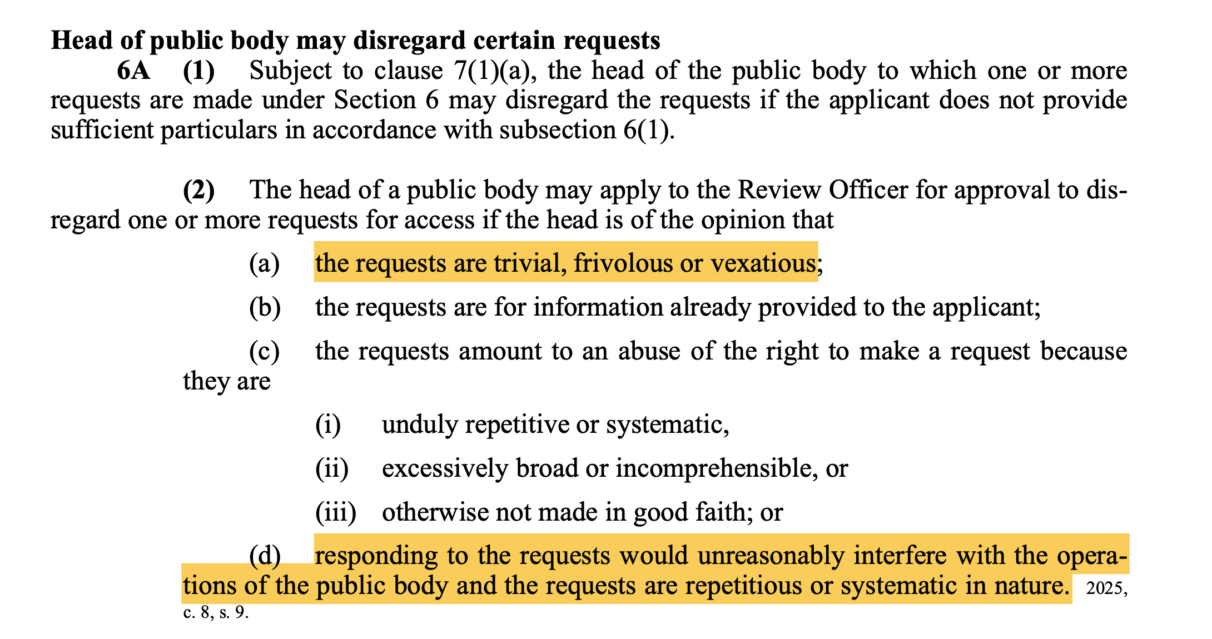
caption
One section of the province’s freedom of information legislation allows Nova Scotia’s bureaucrats to disregard requests for information if they think the request is trivial or frivolous.The clause has caused concerns about the way freedom of information requests are handled.
Prior to her stint as information commissioner in Nova Scotia, Ralph was legal counsel for the Information and Privacy Commissioner in Nunavut and the Northwest Territories.
She said she would have been happy with either order-making powers or a reverse order-making model — the latter potentially less straining on an already under-resourced office.
“In a reverse-onus making model, if the public body does not agree with the recommendations (by the OIPC), then they have to push it to court so the obligation falls on them, not on the person asking for the information,” she said.
“This is important because public institutions typically have the resources needed to do this, while most applicants do not. Public bodies, not applicants, should carry the burden of justifying their decisions.”
New Democratic Party MLA Paul Wozney, who also serves as the ethics and accountability critic for the legislature, said it is a continuation of a “larger pattern” of the Houston government backing away from a commitment to greater transparency.
“Our concern is that some government official is going to determine what constitutes vexatious or frivolous,” said Wozney.
The NDP have also previously called for the Office of the Information and Privacy Commissioner to have order-making powers.
Tim Houston and the Progressive Conservatives supported order-making powers in their 2021 campaign, but have since reversed that position.
The party did not respond by deadline to requests for an interview.
The OIPC has an extensive backlog of appealed requests, dating back three years. Applicants must wait for the commission to rule on their requests. Those rulings are only recommendations that the government is not bound to follow.
Information commissioners in British Columbia, Ontario, Quebec, Alberta and Prince Edward Island, however, can issue binding orders.

Leave a Reply